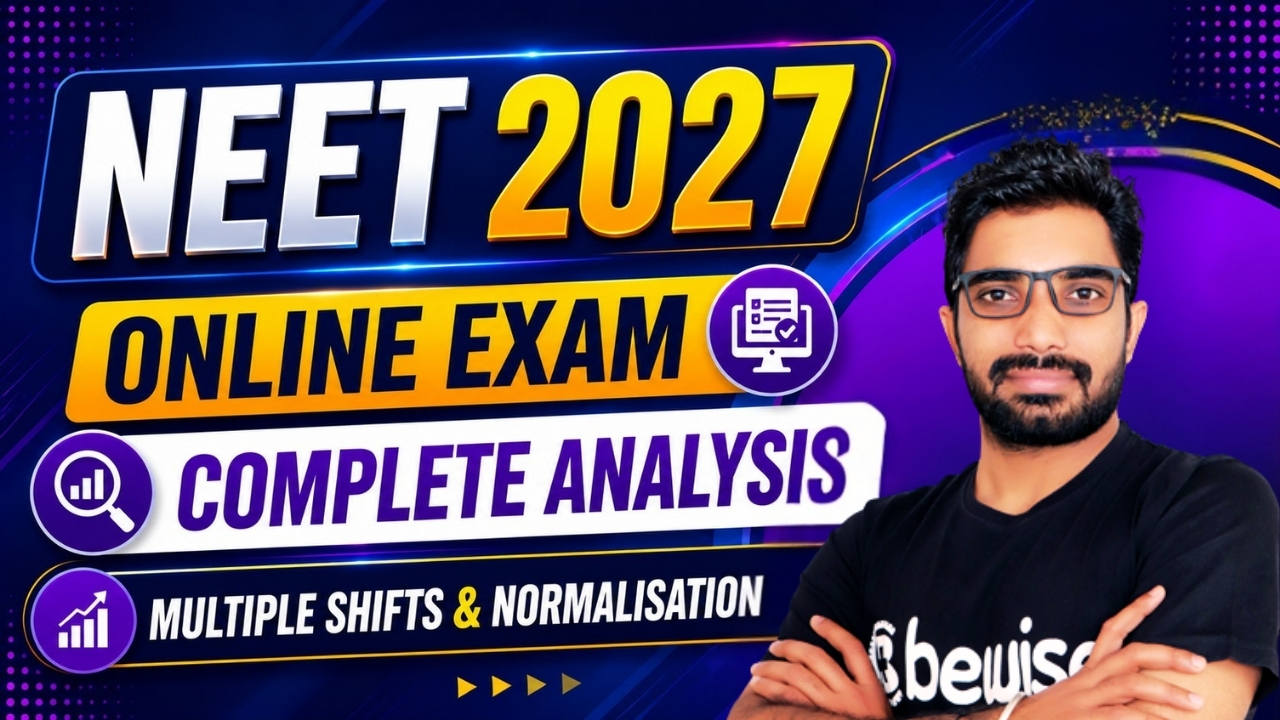
Are you wondering how the transition to neet 2027 cbt mode will affect your medical career plans? With the recent announcement by the Education Minister, the shift to a computer based test is now a reality for the NEET 2027 exam. This article explains exactly how the digital transition works, what normalization means for your rank, and how you can adapt your preparation to stay ahead.
Key Takeaways
NEET 2027 will fully transition from pen-and-paper to Computer-Based Test (CBT) mode.
A normalization process based on percentile scores will be used to ensure fairness across multiple shifts.
The digital interface allows students to edit answers and mark questions for review, unlike OMR sheets.
The core syllabus and marking scheme remain unchanged despite the shift in exam delivery.
The medical entrance landscape in India is witnessing its most significant reform in decades. On May 15, 2026, Union Education Minister Dharmendra Pradhan officially confirmed that the National Eligibility cum Entrance Test (NEET-UG) will move to a computer based test format. Starting with the 2027 academic session, the traditional pen-and-paper method is being retired in favor of a secure, technology-driven platform.
For millions of aspirants, this neet 2027 cbt mode represents both a challenge and an opportunity. While the academic depth of Physics, Chemistry, and Biology remains rooted in the NCERT curriculum, the physical act of taking the test will change completely. You will no longer bubble OMR sheets; instead, you'll navigate a digital interface that offers more flexibility but requires a different set of time-management skills.
Want to Crack NEET 2027 with 700+ Marks?
Join Our DREAM 2027 Batch & learn with Top Faculty from Kota
The transition to a NEET computer based test is no longer just a topic of discussion. Union Education Minister Dharmendra Pradhan has officially addressed the need for reform, emphasizing that the shift to CBT mode is a priority for the government. Furthermore, in recent submissions to the Supreme Court, the National Testing Agency (NTA) confirmed that while the immediate focus remains on streamlining current processes, the NEET 2027 cycle is the definitive target for implementing the CBT format. This move is primarily aimed at enhancing exam security, preventing paper leaks, and eliminating the logistical risks associated with traditional physical question papers.
Announced by Education Minister Dharmendra Pradhan
Legal Context
NTA submission in Supreme Court
First Online Session
May 2027 (Expected)
Security Protocol
End-to-end Encrypted Server Delivery
What is CBT Mode?
A Computer-Based Test (CBT) is an assessment where you read questions and submit responses using a computer terminal at a designated center. Unlike the old format, the neet 2027 cbt mode doesn't involve physical booklets. Each student is assigned a specific terminal where the question paper is downloaded shortly before the exam begins through a secure local server.
When you sit for the NEET online exam 2027, you will encounter a dashboard containing a question palette. This palette uses color codes to show your progress:
White: Questions you haven't visited yet.
Red: Questions you've visited but haven't answered.
Green: Answered questions.
Violet: Questions marked for review.
You'll use a mouse to select options and can navigate between sections (Physics, Chemistry, Botany, and Zoology) with a single click. A countdown timer remains visible on your screen, ensuring you know exactly how many minutes are left.
The NEET 2027 CBT mode interface features a color-coded question palette and navigation for all four subjects.
Why is NTA Considering CBT for NEET?
To prevent leakage issues and ensure a more secure examination environment, the NTA is considering a shift toward the computer-based test (CBT) model. This decision stems from the need to modernize one of the world's largest competitive exams and safeguard its integrity.
The traditional paper-based system faces immense pressure due to the sheer volume of logistics involved in printing and transporting physical papers across thousands of centers. Digital delivery eliminates the risk of paper leaks during transit and storage, as encrypted questions are only decrypted locally at the time of the exam.
The transition also offers operational benefits for both the organizers and students, as outlined in the comparison below:
Feature
Paper-Based Mode (Current)
Computer-Based Test (CBT)
Question Security
Physical transport increases leak risks
Encrypted digital delivery at exam time
Response Markers
Permanent OMR bubbling; no corrections
Ability to change/edit answers before final submit
Data Integrity
Manual collection of physical sheets
Real-time recording on centralized secure servers
Result Timeline
Weeks required for OMR scanning and verification
Significantly faster automated processing
Error Handling
High risk of stray marks or wrong bubbling
Built-in logical validation and "Review" flags
Furthermore, result processing becomes significantly faster as the system automatically records your responses the moment you click save, reducing the long waiting period for merit lists and counseling rounds.
NEET Pen-Paper Mode vs CBT Mode
Understanding the comparison between the old and new formats is vital for your neet 2027 cbt mode preparation. The strategic shift is not about the subjects you study, but how you interact with the content. In the pen-paper mode, once you shade a bubble in blue or black ink, it's permanent. In CBT, you have the freedom to change your mind as many times as you want until the final timer runs out.
One of the most frequent neet 2027 exam mode updates concerns the shift structure. Because most computer labs cannot accommodate 25 lakh students at the exact same moment, the NTA is likely to follow the JEE Main model. This means NEET could be spread over 2 to 3 days with two shifts per day. This transition ensures that every candidate gets a functional computer terminal and adequate space, but it also introduces the need for normalization to maintain a level playing field.
What is Normalization in NEET CBT?
Normalization is a statistical method used to compare candidate scores across different sessions or shifts. Since the difficulty level of a morning paper might slightly differ from an afternoon paper, the raw marks are converted into percentile scores. This ensures that a student who gets a moderately tough paper isn't at a disadvantage compared to someone who gets a relatively easier one.
Your rank won't be based on absolute marks like 680 or 700 alone, but on how you performed relative to others in your specific shift. The formula looks at the total number of candidates whose raw score is less than or equal to yours in that session. It's a proven system that has worked for years in engineering entrance exams.
How normalization ensures fair ranking by converting raw marks into shift-wise percentile scores.
How Normalization May Impact NEET Ranks
In the neet 2027 cbt mode, normalization could lead to situations where two students with different raw scores end up with the same percentile. To break ties, the NTA usually prioritizes marks in Biology, followed by Chemistry and Physics. The total number of incorrect attempts also plays a role. It's vital to focus on accuracy; even with the flexible interface, too many wrong guesses can pull your percentile down significantly.
Biggest Advantages of CBT Mode
Many students are worried, but there are clear advantages of NEET 2027 online examination. First, there's no risk of bubbling errors. Many students lose 10-20 marks every year by accidentally shading the wrong circle on an OMR sheet. In CBT, this error is zero. Second, the 'Mark for Review' tool is a massive tactical advantage. You can flag a tricky thermodynamics problem, move on, and quickly return to it by clicking its violet icon on the palette. No more flipping through paper pages to find that one question you skipped.
Environmental and Logical Benefits
Moving to a digital format saves massive amounts of paper and reduces the carbon footprint of the examination process. Logistically, it allows the NTA to set up centers in more urban locations with better infrastructure, potentially reducing travel time for many students.
Despite the perks, there are hurdles. Screen fatigue is real; staring at a bright monitor for 3 hours can cause eye strain and headaches. Students from rural areas might face a digital divide if they haven't had consistent access to computers. Additionally, you cannot underline keywords in the question as you would on paper, which requires a mental shift in how you process information.
How Should NEET 2027 Aspirants Prepare for CBT Mode?
Your NEET 2027 CBT Mode Preparation should begin now. Don't wait until the last month to touch a computer. Start by converting your weekly tests to a digital format.
Use a computer, not a mobile, for mock tests to simulate the desktop experience.
Practice scrolling efficiently through long passages, especially in Biology.
Develop a 'rough sheet habit' where you organize your calculations on a piece of paper since the question won't be right next to your pen.
Analyze your digital trial runs to see how much time you save by not bubbling OMR sheets and re-invest that time into difficult Physics numericals.
What Should Parents Know About NEET 2027 CBT?
Parents should understand that the academic rigor isn't changing. Your child still needs to master chemical reactions and the Krebs cycle. However, you can support them by ensuring they have access to a desktop or laptop for practice. Encourage them to take eye-rest breaks and don't panic about technical glitches; NTA centers have buffer systems and power backups to ensure no exam time is lost due to hardware failure.
Expert Analysis: How CBT Mode Could Change NEET Preparation
Experts believe that the neet 2027 cbt mode will make the exam more about efficiency and less about clerical accuracy. The focus will shift heavily towards 'reading speed' on-screen. Since students can modify answers, we might see slightly higher cut-offs as the margin for 'silly errors' in shading decreases. The ability to jump between sections instantly also means students will need a more holistic command of the full syllabus rather than getting stuck in one subject pocket.
The shift to NEET 2027 CBT mode marks a pivot toward a more secure and modern medical entrance process. While the digital interface requires a transition in your testing habits, the core academic requirements remain grounded in NCERT concepts. By practicing with online mock tests and understanding the normalization process, you can turn this change into a competitive advantage. Start your digital prep today to ensure that by 2027, the computer is your ally, not an obstacle.
Want to Crack NEET 2027 with 700+ Marks?
Join Our DREAM 2027 Batch & learn with Top Faculty from Kota
While Union Education Minister Dharmendra Pradhan and the NTA have informed the Supreme Court about the intent to move NEET-UG to a Computer-Based Test (CBT) format to enhance security, an official public notification for the 2027 session is currently awaited. Students are advised to monitor the official NTA website for the final confirmation regarding the mode of examination.
How to prepare for NEET computer based test effectively?
Effective preparation involves shifting from OMR practice to digital mock tests. Use a computer and mouse to get used to the interface, learn to use features like 'Mark for Review,' and practice managing your calculation space on separate rough sheets provided at the center.
What are the benefits of online NEET exam for students?
The primary benefit is the ability to change answers at any time, which isn't possible on OMR sheets. It also eliminates shading errors, provides an accurate on-screen timer, and allows for faster result processing and more transparent normalization.
How does the normalization process work in NEET CBT?
Since the exam may happen in multiple shifts, normalization converts raw scores into percentile scores. This accounts for variations in difficulty levels between sessions, ensuring that rank calculation is fair for all candidates regardless of which shift they attended.
Will rough sheets be provided for Physics and Chemistry in CBT mode?
Yes, the NTA provides physical rough sheets for calculations. You will be allowed to use these for all subjects, and you must return them to the invigilator after completing the examination.
Is NEET syllabus going to change for 2027 due to CBT?
No, the syllabus remains the same. The transition to CBT only affects the mode of delivery and the way you mark your answers. The academic content continues to be based on the National Medical Commission (NMC) guidelines and NCERT textbooks.
What happens if my computer fails during the online NEET exam?
NTA centers are equipped with buffer systems. If your terminal crashes, your progress is saved on the local server. You will be moved to a different computer, and your remaining time will resume exactly from where it stopped, ensuring no loss of time.
Will NEET 2027 follow the old pattern of questions?
The core structure of the NEET exam remains consistent. There are a total of 180 compulsory questions to be answered: 45 in Physics, 45 in Chemistry, and 90 in Biology (Botany and Zoology). While the medium of answering—clicking on a screen instead of bubbling paper—is changing, the question distribution and marks weightage are expected to stay the same.











.png)