Are you wondering if your rank is enough to secure a seat in a premier AIIMS medical institute? The NEET 2026 AIIMS Round 1 Cut Off has finally been released, providing clarity for thousands of MBBS aspirants. Understanding the AIIMS MBBS category wise closing rank 2026 helps you evaluate your admission chances and plan your next steps in the NEET 2026 counselling process effectively.
Key Takeaways
AIIMS New Delhi remains the most competitive with a General category closing rank of 51.
Round 1 closing ranks are strictly based on All India Rank (AIR), not just raw marks.
Reservation criteria significantly impact the closing ranks for EWS, OBC, SC, and ST categories.
Candidates must complete reporting formalities or opt for upgradation after seat allotment.
The Medical Counseling Committee (MCC) has officially released the seat allotment results for the first round of NEET UG 2026 counselling. This announcement is a pivotal moment for students aiming for the All India Institute of Medical Sciences (AIIMS), as it sets the benchmark for the most prestigious medical seats in the country. With the competition intensifying every year, these ranks represent the highest level of academic achievement in the medical entrance exam.
In this article, we provide a detailed breakdown of the NEET 2026 AIIMS Round 1 Cut Off across all 20+ functional AIIMS campuses. By analyzing the closing ranks for General, EWS, OBC, SC, and ST categories, you can gain a realistic perspective on where you stand. Whether you have already been allotted a seat or are looking forward to subsequent rounds, this data is essential for navigating the NEET counselling seat allotment 2026 process.
Understanding the NEET 2026 AIIMS Round 1 Cut Off
The AIIMS cutoff is not a fixed number of marks but rather the All India Rank of the last candidate who secured admission in a particular round. Since the difficulty level of the NEET exam and the performance of candidates vary annually, the MCC uses the closing rank as a standardized measure. In Round 1, the competition is at its peak because top-tier students fill their preferences for the most established AIIMS institutes.
Several factors determine these closing ranks, including the total number of available MBBS seats, the reservation policy, and the specific choices filled by candidates. If you see that the closing rank for your category is lower than your current rank, it means the seats for that specific AIIMS were filled before your turn in the merit list arrived.
Difference Between Opening and Closing Ranks
The opening rank is the rank of the first student to get into a college, while the closing rank is the rank of the very last student admitted to that college in a specific round. For AIIMS New Delhi, the opening rank is often 1, meaning the topper chose it, while the closing rank shows the boundary of admission for that category.
AIIMS Round 1 Cut Off 2026: Category-Wise & College-Wise Data
The following table represents the exhaustive list of AIIMS institutions and their respective closing ranks for Round 1 of the 2026 session. This data is critical for understanding the NEET 2026 round 1 cutoff for AIIMS across different socio-economic categories.
AIIMS New Delhi remains the most sought-after medical college in India. As expected, the AIIMS Delhi Cut Off 2026 is extremely high, reflecting its status as the premier institute for medical education. For the General category, the closing rank was as low as 51, meaning only the top 50-odd rankers in the country secured a seat here in the first round.
The competition isn't just limited to the General category. The AIIMS Delhi opening and closing rank 2026 for reserved categories also show a high level of difficulty. To help you understand the requirements, the table below breaks down the specific ranks needed for each category.
AIIMS Delhi Round 1 Cut Off 2026
Category
Closing Rank
General (GN)
51
EWS
292
OBC
192
SC
793
ST
987
Even for the ST category, the cutoff stood at 987, indicating that one needs to be within the top 1000 ranks nationally to secure a seat at this prestigious institution.
Category-wise closing ranks for AIIMS New Delhi Round 1 admissions based on the 2026 cut-off data.
What is the closing rank for AIIMS Delhi for OBC category?
According to the official data for NEET 2026 Round 1, the closing rank for the OBC category at AIIMS New Delhi is 192. This highlights the fierce competition among candidates in this category.
Top AIIMS Colleges NEET 2026 Cut Off Analysis
Apart from the Delhi campus, several other regional AIIMS have established themselves as centers of excellence. Examining the AIIMS College Wise Cut Off 2026 reveals that Jodhpur, Bhopal, and Rishikesh are the next most preferred choices for toppers.
The following table provides a detailed breakdown of the Round 1 closing ranks for the most sought-after regional campuses across various categories.
Top AIIMS Round 1 Cut off 2026
Allotted Institute
GN
EWS
OBC
SC
ST
AIIMS, Jodhpur
343
879
714
3941
4457
AIIMS, Rishikesh
537
1089
979
6429
8532
AIIMS, Bhopal
567
1220
1084
7782
8673
AIIMS, Bhubaneswar
664
1660
1233
5396
10926
These numbers indicate that students with a rank under 1000 have a high probability of securing one of these top-tier regional campuses in the early rounds of counselling.
The closing ranks for AIIMS are not static and are influenced by several dynamic factors each year. If you are analyzing why the ranks shifted compared to previous years, consider the following:
NEET 2026 All India Rank: The overall performance of all candidates across India determines the rank density.
Number of available MBBS seats: Any increase in seat intake at existing or new AIIMS campuses directly affects the cutoff.
Candidate preferences: The sequence in which students list their preferred colleges in the choice-filling form is the biggest driver of the closing rank.
AIIMS MBBS reservation criteria 2026: Category-specific quotas for EWS (10%), OBC (27%), SC (15%), and ST (7.5%) create different competitive levels.
Round-wise seat availability: As seats get filled in Round 1, the availability for Round 2 decreases, though closing ranks often slide slightly downward.
Choice Filling and Seat Matrix
The Medical Counseling Committee seat matrix provides a clear picture of how many seats are open for each category. Efficient choice filling is the key to maximizing your chances. If a student with a better rank does not choose a specific AIIMS, it opens up a slot for someone with a slightly lower rank.
What to Do After Being Allotted a Seat in AIIMS MBBS Round 1?
Once the NEET 2026 round 1 seat allotment letter is in your hand, you have a specific window of time to act. Failing to follow the MCC guidelines can result in the forfeiture of your seat.
Check Allotment Result: Visit the official MCC website (mcc.nic.in) to verify your result.
Download Allotment Letter: Use your NEET credentials to download the official NEET 2026 round 1 seat allotment letter.
Required Documents: Keep your original documents ready, including the NEET Admit Card, Scorecard, Class 10 & 12 certificates, Category certificate, and ID proof.
Reporting to College: You must physically report to the allotted AIIMS for document verification and fee payment. Check the specific reporting dates provided in the MCC schedule.
Upgradation Option: If you have been allotted a seat but want a better AIIMS, you can choose the 'Upgradation' option while reporting. This allows you to participate in NEET 2026 round 2 counselling for AIIMS without losing your current seat.
Will AIIMS closing ranks decrease in round 2 counselling?
Generally, closing ranks tend to increase (numerically) in Round 2, meaning students with slightly lower ranks may get a chance as some Round 1 candidates vacate seats for other colleges or state quotas. However, for top institutes like AIIMS Delhi, changes are usually minimal.
The NEET 2026 AIIMS Round 1 Cut Off data serves as a vital guide for all medical aspirants. While AIIMS New Delhi continues to be the most competitive, the regional AIIMS campuses offer excellent opportunities for those within the top 4000 ranks. Make sure to stay updated with the MCC website for round 2 schedules and seat vacancy reports. If you have been allotted a seat, complete your reporting on time to secure your future in medicine.
Want to Crack NEET 2027 with 700+ Marks?
Join Our DREAM 2027 Batch & learn with Top Faculty from Kota
What was the AIIMS Delhi cutoff in NEET 2026 Round 1?
For the NEET 2026 Round 1, the closing rank for AIIMS New Delhi was 51 for the General category, 292 for EWS, 192 for OBC, 793 for SC, and 987 for ST candidates.
What is the NEET 2026 cutoff for AIIMS Jodhpur?
The closing rank for AIIMS Jodhpur in Round 1 of NEET 2026 was 343 for General category students. For other categories, it was 879 for EWS, 714 for OBC, 3941 for SC, and 4457 for ST.
Which AIIMS had the lowest cutoff in Round 1?
Based on the 2026 Round 1 data, AIIMS Rewari had the highest closing rank (lowest cutoff) at 3810 for the General category. For the ST category, AIIMS Madurai had the lowest cutoff at rank 44940.
How to check AIIMS MBBS round 1 seat allotment result 2026?
Candidates can check the result by visiting the official MCC website at mcc.nic.in. You need to navigate to the UG Medical Counseling section and click on the 'Round 1 Seat Allotment Result' link, then log in with your NEET UG roll number and password.
What are the documents required for AIIMS MBBS reporting 2026?
Essential documents include your NEET 2026 Admit Card, Rank Letter/Scorecard, Class 10 and 12 mark sheets and certificates, 8-10 passport-size photos, Provisional Allotment Letter, and a valid ID proof like Aadhar or Passport.
How many rounds of NEET counselling are held for AIIMS?
Typically, the MCC conducts four rounds of counselling for AIIMS: Round 1, Round 2, the Mop-up Round (often called Round 3), and a Stray Vacancy Round to fill any remaining seats.
What happens if I don't join the allotted college in NEET round 1?
NEET Round 1 usually has a 'Free Exit' option. If you are allotted a seat but do not report to the college, you can still participate in Round 2 without any financial penalty or losing your eligibility for further rounds.
How to opt for seat upgradation in NEET UG 2026?
To opt for upgradation, you must first report to the college allotted in Round 1, complete the admission formalities, and submit a willingness for upgradation on the MCC portal during the reporting process.
Download Class 11 Chemistry Chapter 1 NCERT Solutions PDF – Some Basic Concepts of Chemistry Step by Step Explanation
Class 11 Chemistry Chapter 1 NCERT Solutions: Step-by-Step Explanations
Are you finding the transition from class 10 to competitive class 11 chemistry a bit overwhelming? Mastering the class 11 chemistry chapter 1: Some Basic concept of Chemistry is your first major step toward cracking exams like NEET. In this guide, we provide class 11 chemistry chapter 1 NCERT solutions & answers with conceptual clarity to help you understand the mole concept and stoichiometry. This guide ensures you build a solid foundation for your upcoming class 11 board exam and entrance examinations like NEET, JEE Mains & CUET.
Key Takeaways
Comprehensive step-by-step solutions for all 36 NCERT exercise questions of Class 11 Chemistry Chapter 1.
Detailed explanations of the Mole Concept, Stoichiometry, and Limiting Reagents.
Summary table of essential formulas including Molarity, Molality, and Mole Fraction.
Practical tips to avoid common calculation errors in empirical and molecular formulas.
Starting your Class 11 journey with Chemistry often feels like learning a new language. This first chapter, Some Basic Concepts of Chemistry, introduces the fundamental building blocks you will use throughout your Class 11 & Class 12. Whether you are calculating the mass of an atom or determining the yield of a reaction, the principles laid out here are non-negotiable for success in competitive exams like NEET.
Many students struggle initially because they try to memorize formulas without understanding the underlying logic. Our Class 11 Chemistry Chapter 1 NCERT Solutions aim to bridge that gap by focusing on the "why" behind each step. By developing these analytical skills, you can approach school tests and entrance exams like NEET, JEE Mains & CUET with much more confidence.
To help you master these topics, we have provided a detailed Some Basic Concepts of Chemistry NCERT Solution guide that covers every exercise question. You can also download PDF of Class 11 Chemistry Chapter 1 NCERT Solution to keep as a handy reference during your daily practice sessions. This resource is designed to simplify complex topics like stoichiometry and the mole concept, ensuring your foundation is rock solid.
Essential Formulas and Chapter Summary
Before diving into the exercise solutions, it is crucial to have the key mathematical tools at your fingertips. These some basic concepts of chemistry class 11 solutions rely heavily on a few core concentration terms, mole relationships, and laws. The following table summarizes the formulas you will need to solve almost every numerical problem in this chapter.


        Concept
        Formula / Definition


        Mole (n) - From Mass
        n = Given Mass (w)Molar Mass (M)


        Mole (n) - From Number
        n = Number of Particles (N)Avogadro's Number  (NA)


        Mole (n) - From Volume
        n = Volume at STP (in L)22.4  L


        Molarity (M)
        M = Moles of soluteVolume of solution in Litres


        Molality (m)
        m = Moles of soluteMass of solvent in kg


        Mole Fraction (x)
        xA = nAnA + nB


        Mass Percent
        Mass of soluteTotal mass of solution × 100
Chemistry isn't random subject; it follows strict rules. You'll encounter five main laws: the Law of Conservation of Mass, Definite Proportions, Multiple Proportions, Gay Lussac’s Law, and Avogadro’s Law. For instance, the Law of Multiple Proportions states that if two elements form more than one compound, the masses of one element that combine with a fixed mass of the other are in a ratio of small whole numbers. This is a favorite topic for important questions for class 11 chemistry chapter 1.
The mole is simply a counting unit, like a dozen. However, instead of 12, it represents 6.022 × 10²³ particles. When students look for class 11 chemistry chapter 1 exercise solutions, the most common hurdle is converting between mass, moles, and number of atoms.
To calculate the molar mass of a compound like H2SO4, you sum the atomic masses: 2 × 1.008 (H) + 32.06 (S) + 4 × 16.00 (O) = 98.076 g/mol.
Remember, atomic mass is for a single atom (in amu), while molar mass is for one mole of atoms (in grams). They are numerically similar but represent very different scales.
Stoichiometry and Limiting Reagents
Stoichiometry is the bookkeeping of chemistry. It allows us to predict how much product we can get from a certain amount of reactant. The first step is always to write a balanced chemical equation. For example, in the production of ammonia:
N2(g) + 3H2(g) → 2NH3(g)
This tells us that 1 mole of nitrogen reacts with 3 moles of hydrogen. If you have less hydrogen than required by this ratio, hydrogen becomes the limiting reagent. It is the reactant that is completely consumed first, stopping the reaction and limiting the final amount of product formed.
Think of it like making a sandwich. If you have 10 slices of bread and 2 slices of cheese, and each sandwich requires 2 bread + 1 cheese, the cheese will run out first. In chemical terms, you calculate the required moles of each reactant and compare them to what you actually have. The one that yields the least amount of product is your limiting reagent.
Step-by-Step Class 11 Chemistry Chapter 1 NCERT Exercise Solutions
Here we tackle the specific problems found in the NCERT textbook. These are essential for mastering the ncert solutions for class 11 chemistry chapter 1 pdf curriculum.
1. Calculate the molar mass of the following:
(i)(ii) (iii)
Solution: Correct Option: , , and .
•Use atomic masses: , , .
•.
•.
•.
2. Calculate the mass per cent of different elements present in sodium sulphate ().
Solution: Correct Option: Descriptive calculation
•Molar mass of .
•Mass per cent of sodium .
•Mass per cent of sulphur .
•Mass per cent of oxygen .
•Therefore, the elements present are sodium , sulphur , and oxygen .
3. Determine the empirical formula of an oxide of iron, which has 69.9% iron and 30.1% dioxygen by mass.
Solution: Correct Option:
•Assume of the oxide: iron and oxygen.
•Calculate moles: mol Fe and mol O.
•Divide by the smallest value: Fe:O .
•Multiply by to obtain whole numbers: Fe:O .
•Therefore, the empirical formula is .
4. Calculate the amount of carbon dioxide that could be produced when
(i)1 mole of carbon is burnt in air.
(ii)1 mole of carbon is burnt in 16 g of dioxygen.
(iii)2 moles of carbon are burnt in 16 g of dioxygen.
Solution: Correct Option:
•Reaction: .
•(i)mole of carbon in excess air produces mole of g.
•(ii)g of mole, producing mole of g.
•(iii)g of is limiting, producing mole of g.
5. Calculate the mass of sodium acetate () required to make 500 mL of 0.375 molar aqueous solution. Molar mass of sodium acetate is 82.0245 g .
Solution: Correct Option:
•Convert volume: .
•Calculate moles: .
•Calculate mass: .
•Required mass of sodium acetate: .
6. Calculate the concentration of nitric acid in moles per litre in a sample which has a density, and the mass per cent of nitric acid in it being 69%.
Solution: Correct Option:
•Mass of solution .
•Mass of of .
•Moles of .
•Concentration .
7. How much copper can be obtained from 100 g of copper sulphate ()?
Solution: Correct Option: 15.44 MOL L^-1
•Molar mass of = .
•Mass fraction of copper = .
•Copper obtained from of = .
•Therefore, the amount of copper obtained is approximately .
8. Determine the molecular formula of an oxide of iron, in which the mass per cent of iron and oxygen are 69.9 and 30.1, respectively.
Solution: Correct Option:
•Assume g of the oxide: iron = g and oxygen = g.
•Moles of iron = mol; moles of oxygen = mol.
•Divide by the smaller value: Fe:O = .
•Therefore, the molecular formula is .
9. Calculate the atomic mass (average) of chlorine using the following data:
% Natural Abundance
Molar Mass
34.9689
36.9659
Isotope
% Natural Abundance
Molar Mass
75.77
34.9689
24.23
36.9659
Solution: Correct Option:
The average atomic mass of an element is calculated by finding the weighted average of the masses of its naturally occurring isotopes. The weighting factor for each isotope is its fractional natural abundance.
Use the formula:
Step 1: Convert each percentage abundance into a decimal.
For :
For :
As a check, the fractional abundances add up to :
Step 2: Multiply the fractional abundance of each isotope by its isotopic mass.
Contribution from :
Contribution from :
Step 3: Add the contributions of both isotopes.
Step 4: Round the result appropriately.
Rounding to two decimal places gives:
Therefore, the average atomic mass of chlorine is .
10. In three moles of ethane (), calculate the following:
(i)Number of moles of carbon atoms.
(ii)Number of moles of hydrogen atoms.
(iii)Number of molecules of ethane.
Solution: Correct Option: Answer
•Each molecule contains carbon atoms and hydrogen atoms.
•Moles of carbon atoms mol.
•Moles of hydrogen atoms mol.
•Molecules of ethane molecules.
11. What is the concentration of sugar () in if its 20 g are dissolved in enough water to make a final volume up to 2 L?
Solution: Correct Option:
•Molar mass of = .
•Moles of sugar = .
•Concentration = .
12. The density of methanol is , what is its volume needed for making 2.5 L of its solution?
Solution: Correct Option:
•Moles of methanol required: .
•Mass of methanol required: .
•Convert density: .
•Volume required: .
•Therefore, the required volume is or .
13. Pressure is determined as force per unit area of the surface. The SI unit of pressure, pascal is as shown below:
If mass of air at sea level is , calculate the pressure in pascal.
Solution: Correct Option:
•Convert mass per unit area: .
•Use pressure , so .
•Therefore, .
14. What is the SI unit of mass? How is it defined?
Solution: Correct Option: Kilogram (kg)
•The SI unit of mass is the kilogram, symbol .
•It is defined by assigning the exact value to the Planck constant.
15. Match the following prefixes with their multiples:
•Significant figures are the meaningful digits in a measured quantity.
•They include all certain digits and the first uncertain digit.
•They indicate the precision of the measurement.
17. A sample of drinking water was found to be severely contaminated with chloroform, , supposed to be carcinogenic in nature. The level of contamination was 15 ppm (by mass).
(i)Express this in per cent by mass.
(ii)Determine the molality of chloroform in the water sample.
Solution: Correct Option: by mass;
•by mass.
•In of water, chloroform present .
•Molar mass of .
•Moles of chloroform .
•Molality .
18. Express the following in scientific notation:
(i)0.0048(ii)234,000(iii)8008 (iv)500.0 (v)6.0012
Solution: Correct Option: Descriptive answer
•(i)
•(ii)
•(iii)
•(iv)
•(v)
19. How many significant figures are present in the following?
(i)0.0025
(ii)208
(iii)5005
(iv)126,000
(v)500.0
(vi)2.0034
Solution: Correct Option: 2, 3, 4, 3, 4, 5
•(i)has significant figures.
•(ii)has significant figures.
•(iii)has significant figures.
•(iv)has significant figures.
•(v)has significant figures.
•(vi)has significant figures.
20. Round up the following upto three significant figures:
•For , retain ; round up to because the next digit is .
•For , retain thousand; round up to because the next digit is .
21. The following data are obtained when dinitrogen and dioxygen react together to form different compounds:
Mass of dinitrogen
Mass of dioxygen
(i)
14 g
16 g
(ii)
14 g
32 g
(iii)
28 g
32 g
(iv)
28 g
80 g
(a)Which law of chemical combination is obeyed by the above experimental data? Give its statement.
(b)Fill in the blanks in the following conversions:
(c)= _____ = _____
(ii)= _____ = _____
(iii)= _____ = _____
Solution: Correct Option: Law of multiple proportions and the given conversions
•The data obey the law of multiple proportions.
•For a fixed mass of dinitrogen, the masses of dioxygen combine in simple whole-number ratios such as and .
•Statement: When two elements form more than one compound, the masses of one element that combine with a fixed mass of the other are in simple whole-number ratios.
•.
•.
•.
22. If the speed of light is , calculate the distance covered by light in .
Solution: Correct Option: LAW OF MULTIPLE PROPORTIONS; (I) , ; (II) , ; (III) ,
•Convert time: .
•Use .
•.
•Distance covered is .
23. In a reaction
Identify the limiting reagent, if any, in the following reaction mixtures.
(i)300 atoms of A + 200 molecules of
(ii)2 mol A + 3 mol
(iii)100 atoms of A + 100 molecules of
(iv)5 mol A + 2.5 mol
(v)2.5 mol A + 5 mol
Solution: Correct Option: Not applicable
•The reaction requires unit of for every unit of .
•(i)is limiting.
•(ii)is limiting.
•(iii)Neither reagent is limiting.
•(iv)is limiting.
•(v)is limiting.
24. Dinitrogen and dihydrogen react with each other to produce ammonia according to the following chemical equation:
(i)Calculate the mass of ammonia produced if dinitrogen reacts with of dihydrogen.
(ii)Will any of the two reactants remain unreacted?
(iii)If yes, which one and what would be its mass?
Solution: Correct Option: ; remains with mass .
• Balance the equation: . • Moles of . • Moles of . • requires ; hence, is the limiting reactant. • Moles of . • Mass of . • Excess . • Mass of unreacted .
25. How are and different?
Solution: Correct Option: ammonia is produced; dihydrogen remains unreacted, with mass .
•The stated result gives ammonia produced.
•Dihydrogen remains unreacted, with mass .
26. If 10 volumes of dihydrogen gas reacts with five volumes of dioxygen gas, how many volumes of water vapour would be produced?
Solution: Correct Option: 10 volumes of water vapour
•Balanced equation: .
•Volume ratio of is .
•volumes of react with volumes of .
•Therefore, volumes of water vapour are produced.
27. Convert the following into basic units:
(i)28.7 pm
(ii)15.15 pm
(iii)25365 mg
Solution: Correct Option: The converted values are:
•.
•.
•.
28. Which one of the following will have the largest number of atoms?
(A) 1 g Au (s) (B) 1 g Na (s) (C) 1 g Li (s) (D) 1 g of (g)
Solution: Correct Option: C
•For a fixed mass, the number of atoms depends on the moles of atoms.
•g Li contains approximately mol of atoms.
•g contains approximately mol of atoms.
•Li provides the greatest number of atoms.
29. Calculate the molarity of a solution of ethanol in water, in which the mole fraction of ethanol is 0.040 (assume the density of water to be one).
Solution: Correct Option: C
•Assume mol of solution: ethanol mol and water mol.
•Mass of water g.
•Volume of water mL L.
•Molarity M.
30. What will be the mass of one atom in g?
Solution: Correct Option: C
•Mass of one atom = atomic mass units.
•atomic mass unit = g.
•Mass = g.
31. How many significant figures should be present in the answer of the following calculations?
(i)
(ii)
(iii)
Solution: Correct Option: C
•(i)The result is limited by , so it should have significant figures.
•(ii)The result is limited by , so it should have significant figure.
•(iii)The sum is , which has significant figures.
32. Use the data given in the following table to calculate the molar mass of naturally occuring argon isotopes:
Isotope
Isotopic molar mass
Abundance
0.337%
0.063%
99.600%
Solution: - Convert the abundances to decimal fractions: , , and . - Calculate the weighted average: . - Report the molar mass to four significant figures: .
33. Calculate the number of atoms in each of the following (i) 52 moles of Ar (ii) 52 u of He (iii) 52 g of He.
Solution: - Use Avogadro’s number, atoms/mol. - For mol of Ar: atoms. - For u of He: atoms. - For g of He: atoms.
34. A welding fuel gas contains carbon and hydrogen only. Burning a small sample of it in oxygen gives 3.38 g carbon dioxide, 0.690 g of water and no other products. A volume of 10.0 L (measured at STP) of this welding gas is found to weigh 11.6 g. Calculate (i) empirical formula, (ii) molar mass of the gas, and (iii) molecular formula.
Solution: - Moles of carbon: ; moles of hydrogen atoms: . - The simplest mole ratio is , so the empirical formula is . - Moles of gas at STP: . - Molar mass of the gas: . - Empirical formula mass is ; . - Molecular formula: .
35. Calcium carbonate reacts with aqueous HCl to give , and , according to the reaction,
What mass of is required to react completely with 25 mL of 0.75 M HCl?
Solution: - Moles of . - From the equation, moles of . - Mass of .
36. Chlorine is prepared in the laboratory by treating manganese dioxide () with aqueous hydrochloric acid according to the reaction
How many grams of HCl react with 5.0 g of manganese dioxide?
Solution: - Molar mass of . - Moles of . - From the equation, moles of . - Mass of .
Solutions are a huge part of this chapter. You need to be comfortable with Molarity (M) and Molality (m). A common exam question involves converting between the two.
Important Note: Molarity depends on volume, so it changes with temperature. Molality depends on mass, making it independent of temperature. This is a key reason why scientists often prefer molality for precise thermodynamic experiments. If you are preparing for competitive exams, you must know these mole concept questions in class 11 chemistry chapter 1 inside out.
Mastering the class 11 chemistry chapter 1 ncert solutions is not just about passing an exam; it is about building the mental framework required for all future science studies. By practicing these stoichiometry and mole concept problems regularly, you ensure that complex topics later in the year feel much more manageable. For more detailed study materials, you can download the ncert solutions for class 11 chemistry chapter 1 pdf to keep for offline revision. Keep practicing, and don't hesitate to revisit these fundamental laws whenever you feel stuck.
Want to Crack NEET 2027 with 700+ Marks?
Join Our DREAM 2027 Batch & learn with Top Faculty from Kota
What are the some basic concepts of chemistry in class 11?
The core concepts include the mole concept, atomic and molecular masses, stoichiometry, limiting reagents, and various concentration terms like molarity and molality. It also covers the laws of chemical combination and uncertainty in measurements using significant figures.
Where can I download ncert solutions for class 11 chemistry chapter 1 pdf?
You can download the solutions for free from reputable educational platforms like BeWise Classes. In this guide we have uploaded Class 11 Chemistry Chapter 1 NCERT Solution as a PDF to help students study without an active internet connection.
Why are ncert solutions important for class 11 chemistry exams?
NCERT solutions are crucial because they follow the official CBSE syllabus and provide the exact level of detail expected in school exams. Additionally, many competitive exams like NEET and JEE directly base their questions on NCERT exercise patterns.
How many questions are in ncert class 11 chemistry chapter 1?
There are a total of 36 exercise questions at the end of Chapter 1. These range from simple molar mass calculations to complex stoichiometry and concentration conversion problems.
What are the mole concept questions in class 11 chemistry chapter 1?
Questions typically involve calculating the number of atoms in a given mass, finding the mass of a single atom, or determining the number of moles in a solution. For example, calculating the number of atoms in 52 moles of Argon is a standard mole concept problem.
Can I get step by step solutions for class 11 chemistry chapter 1?
Yes, our guide provides step-by-step logic for each question from class 11 chemistry chapter 1, including how to set up the molar ratios and apply the laws of chemical combination. This helps you understand the reasoning rather than just the final numerical answer.
Which is the best reference book for class 11 chemistry chapter 1?
While NCERT is the primary source for NEET Chemistry, mastering the NCERT exercises and question patterns should always be your first priority. To make this practice easier, Sunil Sir has published handwritten Chemistry Notes for Class 11 & 12, specially useful for NEET, JEE Main, CBSE, and CUET aspirants. He has also launched the NCERT Drill Book — a dedicated resource for NCERT-based question practice.
NEET 2026 Topper List: AIR 1 Toppers Aryan Gupta & Panshul Bansal | Complete Rank List
NEET 2026 Topper List: Aryan Gupta and Panshul Bansal Secure AIR 1
The NEET 2026 Topper list is finally out, revealing a highly competitive year where nearly 20 lakh candidates fought for a medical seat. With the highest score reaching 715 marks, many students are now looking for the NEET 2026 merit list PDF to check their standing. These results define the admissions for upcoming counseling sessions across India. Let's look at the top scorers and their marks.
Key Takeaways
Aryan Gupta and Panshul Bansal jointly secured All India Rank 1 with 715 marks.
A total of 11.21 lakh candidates qualified out of nearly 20 lakh who appeared.
Women candidates outperformed men, making up over 58% of the qualified pool.
The top 138 candidates all scored 690 marks or above, representing 66 different cities.
The National Testing Agency (NTA) has officially declared the results for the National Eligibility cum Entrance Test (UG) 2026. This announcement includes the comprehensive NEET 2026 Topper list, category-wise cut-offs, and the final answer keys. The examination, conducted on 21 June 2026, serves as the single gateway for undergraduate medical, dental, and AYUSH admissions in India.
This year's data highlights a significant milestone in medical entrance history, with the NTA streamlining the declaration process to keep the counseling calendar on track. From the high-achievers in the general category to the top performers in the SC, ST, and OBC-NCL lists, the result reflects a diverse geographical spread of talent across 36 States and Union Territories.
NEET 2026 Topper List: The AIR 1 Highlights
The race for the top spot ended with two candidates sharing the highest honor. Aryan Gupta from Punjab and Panshul Bansal from Haryana both achieved an incredible 715 marks out of 720. Their performance placed them at a 99.9999 percentile, securing the joint AIR 1 position.
Rank
Candidate Name
State
Marks
AIR 1
Aryan Gupta
Punjab
715
AIR 1
Panshul Bansal
Haryana
715
Interestingly, the data shows that among the top 138 scorers, over 93% were actually first-time test takers. This proves that with the right focus, it's possible to top the exam in your first attempt. Furthermore, 99% of these top rankers fall within the 17 to 19 age bracket.
The NTA NEET result 2026 topper details show that excellence isn't limited to just a few states. The top 20 candidates include names from Punjab, Haryana, Rajasthan, Bihar, Maharashtra, Tamil Nadu, Telangana, and Karnataka.
Diversity in representation is a key takeaway from the NEET UG 2026 toppers marksheet findings. The NTA has released separate lists for OBC, SC, and ST categories to recognize the hard work of students across various backgrounds. Notably, Kudale Shravani Krishna and Riya Ranjan led the OBC (Central List) category with a 99.99965 percentile.
In the Scheduled Caste (SC) category, Sanidhya Kshitij Dongre from Maharashtra grabbed the top position with AIR 28. For the Scheduled Tribe (ST) category, Vivek Meena from Rajasthan emerged as the leader with AIR 260.
State wise NEET toppers 2026 and Score Distribution
The geographical distribution of the NEET 2026 Topper list shows that competitive spirit is alive in every corner of India. While Rajasthan and Punjab had several candidates in the high-score bracket, smaller UTs like Ladakh and Lakshadweep also saw impressive performances from their local toppers.
Score Range
Number of Candidates
Above 700
19
650 and Above
1,492
600 and Above
10,160
500 and Above
90,780
Jigmet Yangchan Lamo emerged as the topper from Ladakh with 530 marks, while Dhruv Tripathi led the Andaman & Nicobar Islands with 606 marks. These numbers help us understand the range of marks required for different state-level quotas.
📄 Click Here to Download Complete NEET 2026 Topper ListDownload PDF ⬇️
Participation of Women Candidates
One of the most remarkable stats from the 2026 results is the dominance of women. More than 58% of the qualified candidates are female. Not only did they qualify in higher numbers, but their qualification rate (56.8%) also exceeded that of male candidates (55.1%).
To view your standing or check the complete NEET 2026 Topper list, you must visit the official NTA website. The scorecard provides a detailed breakdown of your marks and All India Rank.
Here’s how you can access the results: 1. Visit neet.nta.nic.in. 2. Click on the 'NEET (UG) 2026 Result' link. 3. Enter your Application Number and Date of Birth. 4. View and download your scorecard for future counseling reference.
The NTA released the final answer key on 16 July 2026, the same day the results were declared. This transparency helps students verify their scores before the counseling for 15% All India Quota and 85% State Quotas begins.
NEET 2026 Cutoff for Toppers and Qualification
The qualifying marks for NEET 2026 have been published alongside the results. This year, 11.21 lakh candidates out of nearly 20 lakh who appeared have passed the threshold for eligibility. These qualified candidates can now apply for medical, dental, AYUSH, and nursing seats.
The NTA has released the category-wise cut-off scores required to qualify for the medical admission process:
Category
Qualifying Score Range
Qualified Candidates
General / UR
715 - 213
2.91 lakh
Gen-EWS
715 - 213
95,026
OBC-NCL
212 - 177
5.12 lakh
SC
212 - 177
1.59 lakh
ST
212 - 177
63,716
A significant highlight of the result is the high level of participation among women, who represent more than 58 per cent of the total qualified candidates. With the highest score recorded at 715, competition for top-tier medical colleges remains intense. Students should now focus on the MCC website for All India Quota (AIQ) counseling dates and clear their state domicile documentation for state-level admissions.
The NEET 2026 result showcases incredible academic achievements, with Aryan Gupta and Panshul Bansal setting the pace. With 11.21 lakh students qualifying, the counseling process is expected to be intensely competitive. Candidates are advised to keep their scorecards ready and stay tuned to official NTA and MCC updates to secure their medical seats.
Want to Crack NEET 2027 with 700+ Marks?
Join Our DREAM 2027 Batch & learn with Top Faculty from Kota
Aryan Gupta from Punjab (AIR 1) and Panshul Bansal from Haryana (AIR 2) are the top rankers for NEET 2026, both achieving a 99.9999 percentile.
How to check NEET 2026 topper list with marks?
You can check the topper list and individual marks by visiting the official NTA website at neet.nta.nic.in. You will need to log in using your application number and date of birth to access your detailed scorecard and the overall merit list.
What is the highest score in NEET 2026 exam?
The highest performance in the NEET 2026 exam reached a percentile of 99.9999, which was achieved by the top two candidates in the All India Rank (AIR) list.
Where to download NEET 2026 topper list PDF?
The official NEET 2026 topper list PDF is available in the 'Public Notices' section of the National Testing Agency (NTA) website. You can also download the detailed press release containing the rank-wise list directly from the official NTA portal.
Who are the female toppers in NEET 2026?
The top-performing female candidates this year are Kudale Shravani Krishna from Maharashtra, who secured AIR 5, and Riya Ranjan from Bihar, who secured AIR 6. Both candidates achieved a 99.99965 percentile.
How many candidates appeared for NEET 2026?
Close to 20 lakh candidates appeared for the examination at 5,440 centres globally. Out of these, 11.21 lakh candidates successfully qualified for medical, dental, and AYUSH admissions.
Which states performed best in NEET 2026?
The results show a strong performance across various regions, with the top 15 ranks featuring students from Punjab, Haryana, Rajasthan, Bihar, Maharashtra, Uttar Pradesh, Tamil Nadu, and Telangana. Notably, women represented more than 58 per cent of the total qualified candidates.
NEET 2026 Rank vs Marks: Check All India Rank Analysis Based on Official NEET UG 2026 Results
NEET 2026 Rank vs Marks: Detailed Analysis and Official Score Trends
Confused about your NEET 2026 rank vs marks after the latest results? Understanding how your specific score translates into an All India Rank is crucial for navigating upcoming counseling sessions. Whether you are aiming for AIIMS Delhi or a state government medical college, this data-backed breakdown explains what your marks actually mean in the current competitive landscape and which colleges are now within your reach.
Key Takeaways
A score of 700+ marks practically guarantees a seat in top-tier institutions like AIIMS Delhi.
The 650+ marks bracket is ideal for securing seats in India's top 20 medical colleges, including AIIMS Nagpur and Rishikesh.
State quota benefits become significant for candidates scoring between 550 and 600 marks in specific regions.
The official data shows a steep increase in competition, with over 8,400 candidates scoring above 600 marks.
The wait for the results is finally over, and the official NEET 2026 rank vs marks data reveals a shifting competitive landscape for medical aspirants. With the scorecard in hand, the focus now shifts entirely to counseling strategies and understanding where you stand in the national merit list. This year has seen a significant number of high scorers, making every single mark vital for securing a seat in a government medical college.
Analyzing the neet 2026 score vs rank analysis is the first step toward a successful admission process. The distribution of candidates across various mark ranges highlights how the difficulty level and the number of participants have influenced the final ranks. In this guide, we break down the official statistics to help you predict your chances across All India and State quotas.
Official NEET 2026 Rank vs Marks Data
To understand where you stand, we must look at the distribution of candidates across different score brackets. This data is essential for any NEET 2026 rank predictor tool or manual calculation you might perform. The density of students in the 501 to 650 range is particularly high, which directly impacts the closing ranks and competition for government medical seats.
Below is the detailed breakdown of marks range, the number of candidates who scored in that bracket, and the cumulative rank range:
Marks Range
Number of Candidates
Expected Rank Range
701–720
19
1 – 19
651–700
1,371
20 – 1,390
601–650
8,425
1,391 – 9,815
551–600
27,055
9,816 – 36,870
501–550
52,471
36,871 – 89,341
451–500
77,023
89,342 – 166,364
401–450
105,403
166,365 – 271,767
351–400
142,003
271,768 – 413,770
301–350
180,494
413,771 – 594,264
251–300
215,148
594,265 – 809,412
201–250
250,899
809,413 – 1,060,311
151–200
289,565
1,060,312 – 1,349,876
Official distribution analysis of candidate density across different NEET score brackets and corresponding rank ranges.
NEET 2026 Expected Marks vs Rank for Counseling
As you prepare for the choice-filling phase, knowing the neet 2026 expected marks vs rank correlations will help you shortlist realistic college options. The following table provides the specific marks required to achieve certain rank milestones, which is the baseline used by many for neet 2026 college predictor evaluations.
NEET Rank
Marks Obtained
50,000
535
100,000
493
150,000
460
200,000
433
250,000
410
300,000
389
500,000
325
750,000
264
1,000,000
212
1,500,000
126
Expected Category Wise NEET 2026 Cut Off
Based on the latest trends and historical data, the NEET 2026 qualifying marks for different categories across the All India Quota (AIQ) are expected to settle within specific ranges. This category-wise breakdown represents the minimum marks estimated to secure a seat in a government medical college.
NEET 2026 Expected Cut Off Category Wise (All India Quota)
Your marks determine the gateway through which you will enter the medical profession. Whether it is through the 15% All India Quota or the 85% State Quota, identifying the minimum marks for mbbs in neet 2026 for your target region is essential.
NEET 2026 Rank for 700 Marks: The Elite Bracket
If you are in this bracket, you are likely one of the 19 candidates at the very top. You will have your pick of any medical college in India. Admission to AIIMS Delhi is a near certainty, as is a seat in MAMC or VMMC.
NEET 2026 Rank for 650-700 Marks: Top Tier Success
This range safely places you within the top 1,500 ranks nationally. You are guaranteed a seat in India's top 20 medical colleges. Premier institutions like AIIMS Nagpur, AIIMS Rishikesh, and AIIMS Patna are excellent choices at this performance level.
NEET 2026 Rank for 600-650 Marks: Strong Government Leads
With over 8,400 students in this category, it is a competitive but fruitful range. You can expect to secure a good government medical college through both the All India Quota and State Quota. You should focus on reputable state-run institutions that have strong clinical exposure.
NEET 2026 Rank for 550-600 Marks: Strategic State Quota
While the All India Quota might be tight for scores closer to 560, you remain in a strong position for state quota seats in several regions. Specifically, students in West Bengal, Maharashtra, Karnataka, Andhra Pradesh, and Telangana have a solid chance at government seats through their respective state counseling rounds.
Navigating the neet 2026 rank vs marks landscape requires a clear understanding of where the competition peaks. This year's official data confirms that while higher scores are increasingly common, strategic counseling can still land you a dream seat in a government medical college. Always keep your neet 2026 rank list pdf and scorecard ready for the MCC and state-level registration. If you are aiming for top institutions like AIIMS, focus on making these data-driven decisions during your choice filling process.
Want to Crack NEET 2027 with 700+ Marks?
Join Our DREAM 2027 Batch & learn with Top Faculty from Kota
Based on recent data trends, scoring 600 marks will likely place your rank around the 25,000 to 28,000 range. While the 601-650 marks bracket contains a dense cluster of 8,425 students, 600 marks remains a strong score for securing a government medical seat, particularly through state quotas.
What is a good score for NEET 2026 for general category?
For the general category, a score above 662 is considered safe for securing a seat through the All India Quota. For those aiming for prestigious AIIMS institutes, a score of 680+ is highly recommended given the current NEET 2026 rank vs marks trends.
Expected rank for 650 marks in NEET 2026?
A score of 650 marks is expected to land you within the 1,300 to 1,500 rank range nationally. This puts you in a prime position for top-tier state colleges and several established AIIMS campuses across India.
What rank will I get for 500 marks in NEET 2026?
According to the reference dataset, a rank of 1,00,000 corresponds to approximately 493 marks. Therefore, a score of 500 would likely place your rank slightly under the 1,00,000 mark, specifically in the 90,000 to 95,000 range.
How many marks are required for AIIMS Delhi in NEET 2026?
AIIMS Delhi remains the most competitive medical institute in India. To secure a seat here in the general category, you typically need to be in the top 50-100 ranks, which requires a score of 710 to 715 marks based on current data analysis.
What percentile is 600 marks in NEET 2026?
While exact percentiles depend on the total number of test-takers, 600 marks usually places a candidate in the 98th to 99th percentile. This performance indicates that you have scored better than 98% of the total applicants.
Will NEET 2026 competition increase the rank vs marks ratio?
Yes, competition has notably increased. The data shows that even at a score of 550, there are over 27,000 candidates ranked higher in that specific bracket alone. This indicates that for the same marks as previous years, the rank may be lower (higher numerical value) due to improved student performance.
Expected NEET 2026 cut off for government medical colleges?
The expected cutoff for a government medical college under the All India Quota is approximately 662 marks for General and OBC categories. For SC and ST categories, the cutoffs are expected to be around 462 and 445 marks respectively.
NEET 2026 Result Out: Check NTA Scorecard, NEET 2026 Rank vs Marks List, and Cut-off Analysis
NEET 2026 Result Out: Check NTA Scorecard, Rank List, and Cut-off Data
Has the neet 2026 result date been weighing on your mind since the exam ended? The National Testing Agency has officially released the scores, bringing relief to millions of aspirants across the country. You can now access your NEET 2026 scorecard link to verify your performance and plan your next steps for medical admissions. This guide breaks down the official statistics and qualifying marks for this cycle.
Key Takeaways
The NEET 2026 result was officially declared by NTA on 16 July 2026.
A total of 11.21 lakh candidates qualified out of approximately 20 lakh who appeared.
The highest score recorded was 715 out of 720, shared by two candidates.
Women outperformed men, making up over 58% of the total qualified candidates.
The long wait for medical aspirants is finally over. The National Testing Agency (NTA) has formally announced the results for the National Eligibility cum Entrance Test (Undergraduate) 2026. This year, the process was streamlined through parallel processing and the de-linking of OMR challenges from the answer key release, ensuring that the results were declared in time for the upcoming counseling sessions.
Close to 20 lakh students sat for the examination on 21 June 2026, across 5,440 centres globally. With the result now live, candidates are eager to see how they performed against the national merit. Understanding the data behind these results, from category-wise qualifying marks to the geographical distribution of toppers, is essential for every student aiming for a seat in MBBS, BDS, or AYUSH programs.
Official NEET 2026 Result Date and Timeline
The NTA followed a rigorous yet efficient schedule to ensure candidates could begin their counseling journey without delays. The entire process from the exam date to the final declaration lasted less than a month. Below is the official timeline as per the National Testing Agency press release.
Event Milestone
Official Date
NEET (UG) 2026 Exam Date
21 June 2026
Provisional Answer Key Release
25 June 2026
Answer Key Challenge Window
25 to 28 June 2026
Display of Scanned OMR Sheets
13 to 15 July 2026
Final Answer Key Publication
16 July 2026
NEET 2026 Result Declaration
16 July 2026
How to Use the NEET 2026 Scorecard Link
Accessing your results is straightforward if you have your login credentials ready. The NTA NEET 2026 official website is the only authorized platform for downloading your individual performance reports. It is important to download and save the document as it will be a mandatory requirement during the NEET 2026 counseling schedule.
Step-by-Step Guide to Download Scorecard
To check your result, you need to visit the official website and look for the result link on the homepage. Candidates can access their scorecards through the official NTA portals. The direct links for the NEET 2026 result are:
You will need your application number and date of birth to log in and access your performance data. Once the details are verified, your scorecard will appear on the screen, showing your total marks, percentile, and All India Rank (AIR). If you find any discrepancies, you should contact the NTA helpdesk immediately at 011-40759000.
This year saw a competitive landscape with 11.21 lakh candidates qualifying for various medical seats. The NTA provided a detailed breakdown of qualified candidates across different categories. These numbers directly influence the closing ranks for top medical colleges.
Category
Number of Qualified Candidates
General
2.91 lakh
OBC-NCL
5.12 lakh
SC
1.59 lakh
Gen-EWS
95,026
ST
63,716
PwBD
3,666
PwD
303
Interestingly, more than 58 percent of the successful candidates are women. The qualification rate for female candidates was 56.8 percent, which was higher than the 55.1 percent recorded for male candidates. This trend highlights the growing participation of women in the medical profession.
Who is the Topper of NEET 2026?
The title of topper of NEET 2026 is shared by two outstanding students who both achieved a score of 715 out of 720. Aryan Gupta from Punjab and Panshul Bansal from Haryana jointly secured the highest marks in the country. They are part of a very elite group, as only 19 candidates managed to score above 700 marks this year.
The NEET 2026 merit list PDF also showcases incredible performances from various states. For instance, Jigmet Yangchan Lamo topped Ladakh with 530 marks, while Dhruv Tripathi led the Andaman and Nicobar Islands with 606 marks. Even in smaller regions like Lakshadweep, candidates like Fahmida Anees (573 marks) showed high academic standards. NTA reported that 138 top rankers, who scored above 690 marks, came from 66 different cities.
Understanding where you stand in the score distribution can help you estimate your chances during the NEET 2026 counseling result phase. High scores were competitive across the board, with nearly 10,000 students crossing the 600-mark threshold.
Above 700 Marks: 19 candidates
Above 690 Marks: 138 candidates
Above 650 Marks: 1,492 candidates
Above 600 Marks: 10,160 candidates
Above 500 Marks: 90,780 candidates
Most of the top-tier scorers were between 17 and 19 years of age. A notable point from the data is that 93 percent of the top 138 rankers were first-time test takers, proving that focused preparation for the initial attempt is highly effective.
Now that the results are out, the next step is participating in the counseling process. It is vital to remember that NTA's role is limited to conducting the exam and declaring the All-India Rank. The actual seat allocation is handled by other authorities.
For the All-India Quota (15%) in MBBS and BDS, the Medical Counselling Committee (MCC) is the primary contact. For AYUSH courses like BAMS, BUMS, and BHMS, the AACCC manages the quota. State authorities handle the remaining 85% of institutional seats based on domicile rules. Candidates should check the NEET 2026 counseling schedule on mcc.nic.in and respective state portals.
NTA has cautioned students against potential scams. Do not trust any communication asking for money for seat blocking or score improvements. Official updates are only provided through verified NTA and MCC websites.
The declaration of the NEET 2026 result date marks the beginning of the admission season for future doctors. With 11.21 lakh students qualifying, the competition for top colleges will be intense. Be sure to download your scorecard immediately and keep an eye on the MCC website for the upcoming counseling rounds. Congratulations to all the successful candidates who have taken their first step toward a medical career.
Want to Crack NEET 2027 with 700+ Marks?
Join Our DREAM 2027 Batch & learn with Top Faculty from Kota
The NEET 2026 results were officially declared on 16 July 2026. The National Testing Agency typically uploads the links in the afternoon, and scorecards are now available for download on the official NTA NEET website.
Is the NEET 2026 merit list released?
Yes, NTA has released the comprehensive data for the merit list alongside the results. You can find the topper lists, category-wise rank details, and state-wise performance charts on neet.nta.nic.in.
How many students appeared for NEET 2026?
Close to 20 lakh candidates appeared for the NEET (UG) 2026 examination. Out of these, 11.21 lakh students successfully qualified for admission to various undergraduate medical, dental, and AYUSH programs.
What is the qualifying marks for NEET 2026?
The qualifying marks or cut-off percentiles are declared category-wise by the NTA. For this session, a score of 500 or above was achieved by 90,780 candidates, while 10,160 students scored 600 or above.
Where is the direct link for NEET 2026 result?
Candidates can access their scorecards through the official NTA portals. The direct links for the NEET 2026 result are:
* [Link 1: cnr.nic.in/ResultDir/Ntnt/Login](https://cnr.nic.in/ResultDir/Ntnt/Login)
* [Link 2: examinationservices.nic.in/ResultoService26/Ntnt/Login](https://examinationservices.nic.in/ResultoService26/Ntnt/Login)
You will need your application number and date of birth to log in and access your performance data.
When will NTA release the NEET 2026 final answer key?
The final answer key for NEET 2026 was published on 16 July 2026, the same day the results were declared. This followed the verification of challenges submitted by students during the window from 25 to 28 June 2026.
How can I check my NEET UG result 2026 by SMS?
Currently, the primary and most reliable way to check the NEET UG result is through the official website neet.nta.nic.in. NTA does not typically provide scorecards via SMS to maintain candidate privacy and data security.
What rank is 700 marks in NEET 2026?
In the 2026 cycle, scoring 700 marks out of 720 is an exceptional achievement. Only 19 candidates scored above 700, while 138 candidates scored above 690. A score of 700 would likely place a candidate within the top 20 to 50 ranks nationally.
NEET 2026 OMR Response Sheet Released Today | Complete Guide to Download & Challenge OMR Sheet | NEET 2026 Result expected on 18th July
NEET 2026 Scanned OMR Answer Sheet Released today | NEET 2026 Result expected on 18th July
Did your long-awaited neet 2026 omr sheet release date finally arrive? The National Testing Agency has officially uploaded the scanned images of responses for the medical entrance exam. You can now verify your marked answers and calculate your scores using the neet 2026 answer key date information to ensure every bubble you shaded matches the official record correctly. This guide explains how to challenge discrepancies and provides the expected NEET 2026 result date and time, helping you confirm your scores before the final merit list is officially declared.
Key Takeaways
NTA released the scanned OMR images and recorded responses on July 13, 2026.
Candidates have until 11:00 AM on July 15, 2026, to challenge any discrepancies.
A non-refundable processing fee of ₹200 is required for each response challenged.
The final result and official answer key are expected to be announced around July 18, 2026.
The National Testing Agency (NTA) has officially moved into the final phase of the medical entrance cycle. For thousands of students who appeared for the re-exam on June 21, 2026, the wait is over. The authority has now made the scanned images of the OMR answer sheets and recorded responses available for download. This step is crucial because it allows you to see exactly what the OMR scanner read from your physical sheet during the evaluation process.
Accessing these documents is the only way to ensure that your hard work translates into the correct score. Along with the web portal access, NTA has also sent these scanned images to your registered email addresses. If you notice a mismatch between what you marked in the exam hall and what the computer has recorded, you have a very narrow window to raise an objection. This guide breaks down the timelines, the fee structure, and the step-by-step procedure to manage your challenges effectively.
Official NEET 2026 OMR Sheet Release Date and Deadlines
It's vital to keep track of the specific timeline provided by the NTA. The window for viewing and challenging the responses is quite short, lasting only a few days. If you miss this period, you won't be able to raise any objections regarding your recorded marks later.
Below is the official schedule as released by the National Testing Agency for the 2026 cycle:
Examination Event
Details / Fees
Start Date
End Date
Recorded Response Challenge
₹200/- per challenge (Non-refundable)
13 July 2026
15 July 2026 (11:00 AM)
Payment Deadline
Online Mode Only
13 July 2026
15 July 2026 (11:00 AM)
Expected Result Date
Final Scoreboard & Merit
-
18 July 2026 (Expected)
Official NTA timeline for the NEET 2026 response challenge window and expected final result date.
Steps to Get NEET 2026 OMR Sheet & Download Link
Accessing your results folder requires following a specific security protocol established by the NTA. They have implemented a Two-Factor Authentication (2FA) system this year to protect your personal data and ensure that only you can see your answers.
To view your responses, you must use the official portal. Below is the direct link and the workflow you need to follow.
First, you need to visit the official website at neet.nta.nic.in. You will be asked to log in using your Application Number and the password you created during registration. After entering these details, the system will send a One-Time Password (OTP) to your registered mobile number and email ID. You must enter this OTP to complete the 2FA process and gain access to the dashboard.
Step-by-step guide to logging into the official portal and completing the 2FA process for dashboard access.
Viewing the Scanned Image
Once you are inside the portal, look for the link that says "View/Challenge OMR Sheet & Recorded Responses". When you click this, the screen will show a high-resolution scanned copy of your actual OMR sheet. Next to it, you'll see a list of how the machine read each question. It's smart to have your copy of the paper ready so you can cross-check question by question.
If you find that the computer has missed a bubble or misread one of your answers, you have the right to challenge it. However, the NTA is very strict about how these challenges are submitted. Follow these steps carefully to ensure your objection is taken into account.
Identify the Mismatch: Scroll through the question-by-question response list. If a recorded option differs from what is visible on your OMR image, select that specific question number.
Select Claimed Option: Tick the box for the option you believe you actually marked on the physical sheet.
Calculate the Fee: Each challenge carries a processing fee of ₹200. The system will automatically calculate the total amount based on the number of corrections you are requesting.
Submit and Pay: The payment must be made online via Net Banking, Debit/Credit Card, or UPI by the deadline of 11:00 AM on July 15, 2026. Without the receipt of this fee, no challenge will be entertained.
Acknowledgment: After successful payment, download the Acknowledgment Page. This document contains your transaction details and a summary of your challenges, which you might need if there are further queries.
Crucial Guidelines for Valid OMR Responses
It's important to remember that not all markings on a sheet are considered valid. The OMR scanner follows a specific set of rules. For example, if you marked more than one circle for a single question, the scanner will treat it as an invalid response, which attracts negative marking.
Only circles that were completely darkened using a Blue or Black Ball Point Pen are recognized. If you used a pencil, or if you only partially filled a circle, the scanner might not pick it up. Additionally, stray marks or spots on the page can sometimes lead to machine errors. NTA makes it clear that they will not entertain challenges based on tampered or manipulated images; doing so could even lead to legal proceedings under Unfair Means (UFM) rules.
NEET 2026 Expected Result Date and Final Answer Key
Many students are asking: what happens after the challenge window closes? Historically, the NTA takes about two to three days to process the valid objections and finalize the data. Since the neet 2026 omr sheet release date ends on July 15, we can reasonably expect the results to be declared around July 18, 2026.
The final answer key will be released along with the result. It's important to note that the window for challenging the answer keys has already concluded. The current window is strictly for OMR response challenges. Once the results are generated, no further requests for re-evaluation or re-checking will be considered, as the machine-readable data is final after the challenge process.
The release of the OMR sheet is a vital final checkpoint for every aspirant. By logging in before the July 15 deadline, you ensure that your scores are calculated fairly and accurately. Remember to pay the ₹200 fee for any challenges and keep your acknowledgment page safe. As we approach the expected result date of July 18, make sure you have all your credentials ready to view your final rank. Stay focused and keep an eye on the official NTA website for the latest updates.
Want to Crack NEET 2027 with 700+ Marks?
Join Our DREAM 2027 Batch & learn with Top Faculty from Kota
Yes, the NTA released the NEET 2026 OMR sheet and recorded responses on July 13, 2026. Candidates can now log into the portal to view their scanned images.
How to download NEET 2026 OMR response sheet?
Visit neet.nta.nic.in, log in with your application number and password, and complete the Two-Factor Authentication. Then, click on the 'View/Challenge OMR Sheet' link to download the PDF.
What is the fee for NEET 2026 OMR challenge?
The processing fee for challenging a recorded response is ₹200 per question. This fee is non-refundable and must be paid online via debit/credit card or net banking.
Will NTA send NEET 2026 OMR sheet to email?
Yes, as per the official public notice, NTA has sent a scanned image of the OMR Answer Sheet to the registered email addresses provided by the candidates during registration.
When will NTA release NEET 2026 OMR result?
The neet 2026 expected result date is July 18, 2026. This typically follows 2-3 days after the OMR challenge window closes on July 15.
How to check scanned image of NEET 2026 OMR if the portal is slow?
If the official website is slow due to high traffic, you should check your registered email inbox (including the spam folder) as NTA sends the scanned copy directly to candidates' emails.
Can I get a copy of my NEET OMR sheet 2026 after the deadline?
No, challenges and downloads must be completed within the specified window ending at 11:00 AM on July 15, 2026. NTA does not entertain requests after this period.
What is the official website for NEET 2026 OMR download?
The official websites for all OMR and result-related updates are neet.nta.nic.in and nta.ac.in. Always use these official links to avoid security risks.
50% Board Exam Weightage in NEET & JEE? 🚨 Will the Government Implement This Proposal?
Board Exam Weightage in NEET: Is the 50% Rule Coming Soon?
Does board exam weightage in NEET matter more than your actual rank? You've likely heard the reports involving a new committee suggesting class 12 board marks weightage in NEET merit list could hit 50 percent soon. This potential shift targets the high-stakes pressure of a single-day test. Understanding these recommendations helps you plan your preparation journey with clarity and confidence.
A 9-member committee has proposed up to 50% weightage for board marks in admissions presently based on scores of entrance exams like NEET and JEE.
Current NEET rules base selection entirely on the entrance score, using boards only for eligibility criteria.
Proposed reforms aim to curb the dummy school culture and reduce coaching dependence.
Implementation faces major hurdles like mark normalization across different state boards.
The landscape of medical entrances in India is currently witnessing a massive wave of proposed reforms. Recently, a 9-member committee constituted by the Ministry of Education suggested a radical shift: adding up to 50% weightage for board marks in entrance exams like NEET and JEE. This recommendation has rightly sparked intense debate among students, parents, and educators across the country.
For years, the medical entrance system has operated on a binary model. Your Class 12 performance acted merely as a gateway, while your final rank depended purely on one three-hour exam i.e NEET. The committee’s proposal aims to dismantle this high-pressure environment by valuing long-term school performance. However, because this isn't yet a law, students are left wondering what they should prioritize right now board exam or NEET.
In this guide, we'll break down exactly what the new proposal (50% Board weightage in NEET) entails, the current official NTA rules, and why a 50% board weightage system is much harder to implement than it sounds. Whether you're worried about your board percentage or your mock test scores, we've got the answers you need to navigate these updates.
Understanding the Proposal for 50% Board Exam Weightage in NEET
The Ministry of Education’s committee was formed to address deep-rooted issues like paper leaks, evaluation errors, and the growing dominance of coaching centers. Their draft report advocates for a 'less-coachable' and more 'aptitude-oriented' selection process. By introducing board exam weightage in NEET, the government hopes to bring students back to classrooms and away from the 'dummy school' trend.
The committee hasn't just stopped at 50% board exam weightage in NEET. They've also suggested closer alignment between the entrance syllabus and NCERT/Board curriculums. The goal is simple: if you study well for your boards, you should naturally be prepared for your medical entrance. This would theoretically reduce the need for expensive external coaching.
Proposed Reform
Expected Impact
50% Board Weightage
Reduces single-exam stress and values year-long study.
NCERT Alignment
Minimizes the gap between school exams and NEET.
Multiple Attempts
Allows students to improve scores without waiting a full year.
Adaptive CBT
Enhances exam integrity and reduces paper-handling risks.
Key proposals from the Education Ministry’s committee to reform the NEET selection process and reduce coaching dominance.
Is this a Final Decision?
It is vital to note that these suggestions are currently recommendations, not final orders. The government will take a final call only after a thorough review of the committee's complete report. One of the most discussed proposals involves introducing a 50% Board weightage in NEET exam rankings, which would significantly shift the focus toward school academics alongside entrance preparation.
For the current session, the existing system remains in place, and admissions to medical colleges still depend primarily on your NEET score. However, if the ministry moves forward with the 50% Board weightage in NEET exam evaluation, the selection process will become more holistic. Students should continue focusing on their current preparation while staying alert for official notifications regarding these policy shifts.
Current NTA NEET 2027 Eligibility Criteria Explained
While the future might change, you must adhere to the current NTA NEET 2027 eligibility criteria. Presently, your board marks serve as a qualifying threshold. You don't need to top your boards to get an MBBS seat, but you must cross a specific aggregate percentage for NEET in PCB & English to be allowed to sit for the exam.
If you don't meet these minimums, even a high NEET score won't secure your admission. This aggregate is calculated by adding your marks in Physics, Chemistry,Biology and English then determining your percentage. It's different from your total board percentage, which includes English and other electives.
Currently, the answer is a clear 'No' regarding rank calculation. While board marks keep you eligible, they have zero impact on your actual rank. A student who scored 95% in boards and another who scored 55% are treated exactly the same during the counseling process if their NEET scores are identical.
However, board marks do become relevant in 'tie-breaking' scenarios. If two students have the exact same NEET score and the usual criteria (like higher marks in Biology, then Chemistry, then Physics) fail to break the tie, age or application order used to be the factor. Some officials have discussed using board marks as an ultimate tie-breaker, but it's not the primary way ranks are assigned today.
So, when people ask 'does board marks matter in NEET?', they are usually referring to the future prospects. In the present scenario, your focus should remain on the 720 marks of the entrance exam while ensuring you safely cross the 50% (or 40%) PCB barrier.
Why Implementation of the 50% Board Weightage Rule is Challenging
Talk of introducing board marks in entrance ranks isn't new; it has been discussed for over a decade. The reason it hasn't happened yet is due to 'Normalisation.' India has dozens of state boards, plus CBSE and ICSE. Some boards are 'lenient' with marks, while others are notorious for tough grading.
Comparing a 90% in a 'strict' state board to a 90% in a 'liberal' board is unfair. To fix this, a complex mathematical formula would be needed to normalize scores—a process that often leads to legal battles and confusion. Furthermore, the recent focus on paper leaks might be the immediate trigger for these 'reform' headlines, possibly acting as a way to shift public attention rather than being a ready-to-launch policy change.
Practicality dictates that unless every single board in India adopts a uniform testing and evaluation standard, giving boards 50% weightage in entrance exam like NEET & JEE will remain a logistical nightmare.
While the proposal to introduce 50% board exam weightage in NEET sounds like a major shift, it remains a recommendation for the future rather than a current rule. For now, your priority should be mastering the entrance syllabus while maintaining a solid score in your boards to meet eligibility. If you're serious about your medical dreams, stay focused on the fundamentals and keep an eye on official NTA updates.
What do you think about the 50% board weightage idea? Share your thoughts below and stay tuned for more legislative updates.
Want to Crack NEET 2027 with 700+ Marks?
Join Our DREAM 2027 Batch & learn with Top Faculty from Kota
Currently, 12th board marks do not affect your NEET selection or rank calculation. They are only used to determine your eligibility to appear for the exam. However, you must meet the minimum PCB aggregate percentage to qualify for counseling.
Is 12th marks considered for MBBS admission through NEET?
No, MBBS admissions are strictly based on the NEET UG merit list. While a committee has suggested a 50% weightage for boards in the future, the current system relies 100% on the entrance exam score for seat allocation.
What is the proposal for 50% Board exam weightage in NEET?
A high-level 9 members education ministry committee has recommended giving 50% weightage to Class 12 board marks in the final NEET merit list calculation. The goal is to reduce the dependency on coaching centers and encourage students to focus more on their school education.
Will the 50% board weightage be implemented for NEET 2026 or 2027?
As of now, there is no official notification confirming its implementation. While the recommendation has been submitted to the Ministry of Education, any such drastic change requires thorough evaluation and public notice. Students should continue to prioritize their NEET preparation based on the current 100% entrance exam criteria.
Is 12th marks added in NEET rank?
Currently, board marks are not added to your NEET rank. Your rank is generated based solely on your performance in the 720-mark entrance test. The only role boards play is for basic eligibility.
What is the weightage of boards in NEET counseling?
The weightage of board marks in NEET counseling is zero at this time. Counseling authorities like MCC only look at your NEET rank and your eligibility certificate or marksheet to ensure you meet the qualifying criteria.
Does 12th board marks affect NEET rank in 2026?
As of now, there is no official notification that board marks will affect the 2026 rank. While reforms are being discussed, any major change would be announced well in advance by the NTA or the Ministry of Education.
Is class 11 weightage more than class 12 in NEET?
Historically, the NEET question paper shows a nearly balanced split, often around 45% for Class 11 and 55% for Class 12 syllabus. Both years are equally important for a high score.
Do we need 75 percent in boards for NEET?
No, you do not need 75% for NEET eligibility. You only need a 50% aggregate in Physics, Chemistry, and Biology (PCB) for the General category, and 40% for Reserved categories.
How much percentage is required for NEET in class 12th?
You need an aggregate of 50% in PCB if you are in the General category. For OBC, SC, and ST candidates, the requirement is 40% aggregate in PCB subjects.
NEET 2027 Latest News: Will Different States Have Different NEET Exam Dates? Parliamentary Committee Suggests conduct NE
NEET 2027 Latest News: Will Different States Have Different NEET Exam Dates? Parliamentary Committee Suggests conduct NE
Is NEET 2027 in Multiple Phases finally becoming a reality for medical aspirants? Recent discussions between the Parliamentary Standing Committee on Education and the NTA have put the National Eligibility cum Entrance Test 2027 updates in the spotlight. These proposals suggest moving away from a single-day exam to manage growing logistical pressures. We look at how these changes might affect your preparation strategy and future opportunities.
Key Takeaways
A Parliamentary committee has recommended conducting NEET in multiple phases across different states.
The proposal includes potentially holding separate entrance tests for MBBS, AYUSH, and Nursing courses.
Computer-Based Testing (CBT) will only be introduced once digital infrastructure is fully ready nationwide.
NTA currently maintains that a single-day exam ensures fairness and uniform difficulty levels for all students.
The landscape of medical entrance examinations in India is facing a significant turning point. Following the first meeting of the Parliamentary Standing Committee on Education, chaired by Mukul Wasnik, several radical reforms have been proposed to the National Testing Agency (NTA). The primary goal is to address the massive logistical and security challenges that come with managing millions of candidates on a single day.
For students aiming for the 2027 session, these discussions represent a potential shift in how they will compete for a seat. While the NTA has highlighted the success of the recent ReNEET 2026, the demand for more sustainable and transparent systems is growing. This article breaks down the expert recommendations, the agency's official stand, and what it really means for your medical career roadmap.
Why is the Parliamentary Panel pushing for different dates for different states for NEET 2027?
The Parliamentary Standing Committee on Education recently met with the Higher Education Secretary, Vineet Joshi, and the NTA Director General, Abhishek Singh. Their main concern is the 'humongous' logistical pressure created by a single-day, nationwide exam. The committee suggested that conducting the exam on different dates for different states would alleviate these administrative burdens.
Historically, holding the largest entrance exam in the world on one specific day has made the system vulnerable to security risks. By breaking the exam into phases, the panel believes the NTA can focus on better management at the state level. These recommendations also touch upon the security measures seen during the NEET re-exam, where officials noted that a ban on social media channels effectively prevented leaks.
Separate Exams for MBBS, AYUSH & Nursing
Another major suggestion from the panel involves separating the entrance pathways. Currently, NEET serves as the single window for MBBS, AYUSH, and Nursing. The committee proposed holding separate entrance examinations for these three categories. The logic is simple: fewer students appearing for a single examination reduces the strain on centers and staff alike.
NTA Response to Multiple Phases and Different Exam Dates
While the recommendations seek to solve logistics, the NTA has its own set of concerns regarding academic fairness. When the idea of holding NEET on different dates for different states was brought up, the agency pointed out a major technical hurdle: difficulty level parity. It is extremely challenging to create multiple question papers that are exactly equal in difficulty, which could lead to disputes among students from different states.
Recommendation Point
NTA Official Response
Conducting NEET in multiple phases/different dates
Not feasible at once; compromises fairness and difficulty normalization.
Separate exams for MBBS, AYUSH, and Nursing
Not feasible currently as all three programs rely exclusively on NEET scores.
Implementation of Computer-Based Test (CBT)
Agreed; will be introduced only after full digital infrastructure is established.
A breakdown of the NTA's official stance on proposed changes for NEET 2027 and exam logistics.
Will NEET 2027 be conducted in two phases or CBT mode?
There is a growing consensus that the NTA NEET 2027 exam pattern will eventually shift toward a Computer-Based Test (CBT). However, the Parliamentary panel has been very clear: this transition shouldn't be rushed. They insisted that the move to online exams must wait until every student across the country has equitable access to digital facilities.
This means that for the upcoming cycles, the pen-and-paper format might remain the standard until the infrastructure gap is bridged. The debate around the NEET UG exam twice a year also continues, as a multi-phase system naturally leads to the inclusion of a normalization process, similar to how JEE Main is conducted.
If the National Eligibility cum Entrance Test 2027 updates include multiple sessions, the agency would likely adopt a percentile-based normalization. This system accounts for variations in paper difficulty between different shifts, ensuring that a student who gets a tougher set of questions isn't at a disadvantage compared to someone who gets an easier one.
What are the benefits of multiple phases in NEET 2027 for students?
Adopting a multi-stage or phased approach offers more than just logistical ease; it can significantly reduce student anxiety. Currently, a single mistake on one Sunday afternoon can cost a student an entire year. A phased or multi-attempt system would provide a safety net, allowing students to improve their scores without waiting another 12 months.
However, the 'Catch-22' remains the feasibility. As per the meeting held at the Parliament House with K Radhakrishnan and other officials, the priority is maintaining the security and transparency of the exam. The recent re-exam, which was conducted after the NEET-UG 2024 controversy, proved that the NTA can organize exams quickly under tight security, but doing this multiple times a year is a massive undertaking.
To understand why these changes matter, we need to compare the existing system with the proposed reforms. The transition from a single-day event to a phased state-wise schedule is a complete shift in strategy.
Feature
Current Single-Day Model
Proposed Multi-Phase Reform
Exam Dates
One single day nationwide
Varied dates for different states
Logistical Burden
High; requires massive security
Distributed; easier to manage
Evaluation Style
Raw Marks / Rank
Percentile / Normalization likely
Course Selection
One exam for all courses
Possible separate exams for Nursing/AYUSH
The debate regarding NEET 2027 in Multiple Phases highlights a serious effort by the government to reform medical admissions. While the Parliamentary committee is keen on state-wise phases and separate exams for Nursing or AYUSH to manage crowds, the NTA remains cautious about maintaining exam integrity and fairness. As an aspirant, your focus should remain on a robust preparation strategy that covers the core syllabus, regardless of the eventual format. We will keep you updated as the official report from chairperson Mukul Wasnik is released.
Want to Crack NEET 2027 with 700+ Marks?
Join Our DREAM 2027 Batch & learn with Top Faculty from Kota
The Parliamentary Standing Committee on Education has recommended that the NTA conduct NEET in multiple phases. The proposal suggests holding the exam on different dates for different states to manage the massive logistical challenges and security risks associated with a single-day nationwide exam.
Is there a proposal for separate exams for MBBS, AYUSH, and Nursing?
Yes, the Parliamentary panel suggested conducting separate entrance examinations for MBBS, AYUSH, and Nursing courses. This move aims to reduce the high candidate density for a single examination; however, the NTA currently views this as a challenge since all three programs rely on common NEET scores for admissions.
Will NEET 2027 be held on different dates for different states?
This is one of the primary recommendations made by the committee headed by Mukul Wasnik. By staggering the exam dates across states, the government hopes to ensure smoother administration and better monitoring to prevent paper leaks and other irregularities.
Is NEET 2027 going to be an online Computer-Based Test (CBT)?
The transition to a CBT mode is being discussed to improve transparency. However, the panel has asserted that this should only be implemented once the digital infrastructure is fully ready across the country to ensure equitable access for all candidates.
What was the NTA's response to these proposed reforms?
While the NTA elaborated on the security measures taken during recent re-exams, they noted that some changes, like separate exams for different streams, are not feasible presently. Any major shift toward multi-phase or online exams will require thorough preparation and infrastructure development.
How will these changes affect the normalization process?
If the exam is conducted on different dates with different question sets, the NTA would need to implement a normalization process. This ensures that the difficulty level of papers across different phases is balanced, providing a fair percentile-based ranking for all students.
National Doctor's Day 2026: Theme, Wishes, Why It Is Celebrated & How to Become a Doctor
National Doctor's Day 2026: History, Theme, and Career Guide
Do you ever wonder why we dedicate a specific day to those in white coats? Since National Doctor's Day is celebrated to honor the massive impact physicians have on our daily health, understanding its roots is vital. This guide explores the doctor's day 2026 theme and offers a clear roadmap for students aiming to join this noble profession in the coming years.
Key Takeaways
National Doctor's Day is celebrated on different dates globally, with India observing it on July 1st.
The 2026 theme 'Behind the Mask: Who Heals the Healers?' focuses on physician mental health.
Dr. Bidhan Chandra Roy's legacy as a physician and statesman is the foundation of the Indian observance.
A structured path through Science, NEET, and MBBS is essential for aspiring medical students.
Celebrating National Doctor's Day is more than just a calendar event; it's a moment to pause and reflect on the individuals who stand between us and illness. Whether it's a routine check-up or a critical surgery, the medical community carries a weight of responsibility that few other professions experience. For many NEET aspirants, this day serves as a reminder of the goal they are working so hard to achieve.
In India, this observance holds deep historical roots linked to one of the most prolific figures in Indian medicine. As we approach the upcoming year, understanding the significance of National Doctor's Day helps us appreciate the evolving nature of healthcare. This article dives into the history of National Doctor's Day, the 2026 theme, and the practical steps you need to take if you plan to become a healer yourself.
Why is National Doctor's Day Celebrated?
The core reason we celebrate this day is to recognize the tireless service of doctors who work around the clock. In India, National Doctor's Day is celebrated on July 1st to honor the birth and death anniversary of Dr. Bidhan Chandra Roy. He wasn't just a physician; he was a visionary who helped build the medical infrastructure of modern India.
Internationally, the dates vary because each country chooses to link the celebration to its own medical milestones. For instance, the US marks the day in March to commemorate the first use of ether anesthesia. Despite the date differences, the sentiment remains the same: expressing gratitude for the skill and empathy that doctors bring to their practice every single day.
Doctor's Day History in India vs USA
It's interesting to see how different regions chose their specific dates. While India focuses on the legacy of a legendary physician-statesman, other nations focus on scientific breakthroughs.
Region
Date Observed
Historical Significance
India
July 1st
Birth/Death of Dr. B.C. Roy (est. 1991)
USA
March 30th
First use of general anesthesia in 1842
Iran
August 23rd
Birthday of Avicenna
A global comparison of National Doctor's Day dates and their unique historical significance across different regions.
Exploring the National Doctors Day Theme 2026
The theme for National Doctors' Day 2026 is "Behind the Mask: Who Heals the Healers?" This is a powerful shift from focusing solely on patient care to looking at the well-being of the medical professionals themselves. For years, the image of a doctor has been one of invulnerability, but recent global events have shown that burnout and mental health struggles are real challenges in the medical fraternity.
This year's theme encourages hospitals and the public to think about the support systems available for doctors. It's not just about a thank you message for doctors, but about advocating for better work-life balance and emotional health resources within the healthcare system.
If you are an aspiring student inspired by the significance of National Doctor's Day, the journey ahead requires discipline and a clear plan. It isn't just about luck; it's about following a specific academic pathway. Here is how you can move from a school student to a medical professional.
Science Stream with Biology: After completing class 10, you must choose the Science stream (PCB). Physics, Chemistry, and Biology are the core subjects you'll need to master.
Crack the NEET Exam: The National Eligibility cum Entrance Test (NEET) is the mandatory entrance exam in India for undergraduate medical courses. Consistent practice and a strong grasp of NCERT books are key here.
Admission in Medical College: Based on your NEET rank, you will participate in counseling to secure a seat in a government or private medical college for an MBBS degree.
Complete MBBS and Internship: The MBBS course lasts 5.5 years, including a one-year mandatory rotatory internship where you get hands-on experience in various departments.
Post-Graduation (MD/MS): After MBBS, most doctors appear for NEET-PG to specialize in fields like Surgery (MS) or Medicine (MD).
Top Happy Doctor's Day Wishes and Quotes
A simple gesture can go a long way in making a physician feel valued. If you want to show your appreciation, here are some ideas for what to say or share on social media.
Thank you for being the dedicated professional who keeps our community healthy and safe.
Wishing you a day filled with the same joy and relief you bring to your patients daily.
Happy National Doctor's Day! Your hard work and sacrifices do not go unnoticed.
To the one who heals with care and patience—thank you for everything you do.
May you have a wonderful National Doctor's Day, filled with the appreciation you truly deserve.
Your commitment to patient care is an inspiration to all of us. Have a great day!
Thank you for working through the toughest hours to ensure we stay healthy.
Sending warm wishes to a doctor who goes above and beyond for their patients.
Happy Doctor's Day! We are grateful for your expertise and your kind heart.
To our family doctor: Thank you for years of guidance, health, and care.
Inspiring Doctor's Day Quotes
"The art of healing comes from nature, but the address of the physician comes from the heart." — Paracelsus
"Medicines cure diseases, but only doctors can cure patients." — Carl Jung
"Observation, Reason, Human Understanding, Courage; these make the physician." — Martin H. Fischer
"Wherever the art of Medicine is loved, there is also a love of Humanity." — Hippocrates
"A doctor, like anyone else who has to deal with human beings, each of them unique, cannot be a scientist; he is either, like the surgeon, a craftsman, or, like the physician and the psychologist, an artist." — W.H. Auden
Wondering how to celebrate national doctor's day in hospital or at home? It doesn't have to be grand to be meaningful. Simple acts of gratitude often resonate the most with busy healthcare providers.
Write a Heartfelt Note: A personalized thank you note to your doctor sharing how they helped you can be kept for years.
Social Media Shout-outs: Use the latest doctor's day quotes to post a tribute to the medical team that cares for you.
Hospital Staff Appreciation: If you manage a clinic, a small thank-you breakfast or a wall of gratitude where patients post notes can boost morale.
Health Awareness Drives: Use this day to organize a blood donation camp or a free health check-up in your local area to honor the spirit of the profession.
National Doctor's Day reminds us of the human element in healthcare and the immense dedication required to heal others. By understanding the Significance of National Doctor's Day and the challenges faced by medical professionals, we build a more empathetic relationship with those who care for us. Whether you are an aspiring student or a grateful patient, let's use this occasion to support the well-being of our doctors as much as they support ours.
Want to Crack NEET 2027 with 700+ Marks?
Join Our DREAM 2027 Batch & learn with Top Faculty from Kota
National Doctor's Day is celebrated on different dates across the world. In India, it is observed on July 1st, while in the United States, it is celebrated on March 30th. Each date usually commemorates a specific medical achievement or the birth of a renowned physician.
Why do we celebrate National Doctor's Day on July 1st in India?
In India, July 1st was chosen to honor the legendary physician Dr. Bidhan Chandra Roy. This date marks both his birth anniversary in 1882 and his death anniversary in 1962. The day was officially established by the Indian Medical Association in 1991.
What is the theme for Doctor's Day 2026?
The expected theme for National Doctor's Day 2026 is 'Behind the Mask: Who Heals the Healers?'. This theme emphasizes the importance of mental and physical well-being for doctors, acknowledging that they also need care and support to prevent burnout.
How can I show appreciation to doctors during Doctor's Day?
You can show appreciation by sending a heartfelt thank you message for doctors, writing a letter of gratitude, or sharing appreciative quotes on social media. Simple gestures like following medical advice and respecting their time also mean a lot to physicians.
Who was Dr. BC Roy and why is his birthday Doctor's Day?
Dr. Bidhan Chandra Roy was a highly respected physician, a freedom fighter, and the second Chief Minister of West Bengal. He was awarded the Bharat Ratna in 1961. His immense contribution to the Indian medical system is why his birth anniversary was dedicated to all doctors.
What are some creative Doctor's Day gift ideas for staff?
Creative gift ideas for medical staff include personalized stationery, high-quality pens, ergonomic desk accessories, or wellness vouchers like spa sessions or gym memberships. Group gifts like a catered lunch or a 'gratitude wall' with patient notes are also very effective in a hospital setting.
Is Doctor's Day a public holiday?
No, National Doctor's Day is not a public holiday. Hospitals, clinics, and medical institutions remain open and fully functional. The day is observed through special ceremonies, seminars, and appreciation events within the healthcare community.
How do you wish a doctor on Doctor's Day?
You can wish a doctor by saying, 'Happy National Doctor's Day! Thank you for your selfless service and dedication to our health.' Using specific examples of how they helped you or your family makes the wish even more meaningful.
Scored 550, 600, 650 or 700+ in Re NEET 2026? Expected Rank, Category-wise Cutoff & College Options After NTA Answer Key
Scored 550, 600, 650 or 700+ in NEET 2026? Expected Rank, Category-wise Cutoff & College Options After NTA Answer Key
Are you wondering how your NEET 2026 Rank vs Marks profile will look compared to previous years? Understanding if 650 marks will secure a top rank or if 550 marks can fetch a government seat is crucial for your planning. We have analyzed NEET 2026 expected ranks based on Marks and category-wise cut-offs to help you identify which medical colleges match your current score.
Expected rank for 700 marks is projected to be in the top 30 based on recent trends.
A score of 600 marks is likely to fall within the 5,000 to 8,000 rank range.
Students with 550 marks should focus on state quota and new government colleges for MBBS chances.
NEET 2026 Counselling strategy is just as important as your final score in securing a seat.
The release of the NTA answer key marks a pivotal moment for every medical aspirant who appeared in NEET 2026 exam on June 21. While your raw score gives you a starting point, the true competition lies in understanding the NEET 2026 Rank vs Marks analysis. Because thousands of students often score within the same five-mark bracket, even a single correct answer can shift your All India Rank by hundreds of positions.
At this stage, you aren't just looking for a number; you're looking for a roadmap to a medical seat. Whether you've crossed the 700-mark threshold or are hovering around the 550 mark, the admission depends significantly based on category-wise cutoffs and the specific quota you apply through. This guide breaks down exactly what your score means for your future career.
We will explore the specific rank ranges for different score brackets and identify which colleges you may expect at each level in NEET 2026 Counselling. By moving beyond simple predictions and into strategic counselling planning, you can maximize your chances of securing a seat in a Government Medical College (GMC) or a prestigious institute like AIIMS.
To understand where you stand, it is essential to look at how scores translate into ranks. The following table provides the data for NEET 2026 Rank vs Marks analysis based on the latest competitive trends and candidate density. This comparison helps you visualize the student distribution at various score levels, which is crucial for determining your potential standing in the national merit list.
Hitting a score above 700 places you in the elite bracket of aspirants. At this level, every single mark determines your standing among the top 100 students in the country. It's not just about passing; it's about choosing the absolute best institutions available.
Expected Rank: Top 20 – 30
MBBS Chances and College Options: Students in this range have the strongest chances for AIIMS Delhi, the premier medical institute in India. You also become a prime candidate for top-tier central institutes such as MAMC (Maulana Azad Medical College), VMMC (Vardhman Mahavir Medical College), and GMC Chandigarh. Getting 700+ marks in NEET 2026 exam is a significant achievement that opens doors to virtually any college through the All India Quota.
Scoring Around 650 Marks in NEET 2026? Expected Rank & Colleges
A score of 650 is widely considered a very strong competitive mark. It ensures high-level opportunities across both national and state levels.
Expected Rank: 1,000 – 1,200
MBBS Chances and College Options: You can target top-tier AIIMS campuses including AIIMS Rishikesh, Nagpur, Raipur, and Patna. In addition, you are well-positioned for top-tier state government medical colleges like SMS Jaipur or KGMU Lucknow. The NEET score for government medical college pathways is very clear at this level, as you will likely have strong AIQ opportunities and access to high-demand medical colleges in various states.
For many students, 600 marks is the goal that signifies a high probability of a government seat. While the competition is dense here, it remains a very strong score for a successful medical career.
Expected Rank: 7,000 – 8,000
MBBS Chances and College Options: Students in this range are likely to secure seats in Government Medical Colleges across many states. You can expect successful placements through AIQ counselling or popular state-level medical colleges. This score range puts you in a commanding position to negotiate the counselling process and secure a safe seat, especially in states with a higher number of medical colleges.
At 550 marks, the strategy shifts toward exploring all possible avenues. While a seat in a top-tier GMC might be difficult through AIQ, there are still excellent paths to becoming a doctor.
Expected Rank: 26,667 – 35,000
MBBS Chances at 550 Marks: Potential seats in new colleges opened in 2026 through the All India Quota. Government MBBS seats in specific states under the 85% state quota. Semi-government college options. Private medical colleges with relatively lower fee structures. * BDS and AYUSH options in several states.
Expert Advice: If you are in this range, you must participate in all counselling rounds. Keep your state quota options open and prepare a broad list of colleges to ensure you don't miss out on a seat during the mop-up or stray vacancy rounds.
Securing a seat in a Government Medical College (GMC) remains the primary goal for most candidates. Based on historical trends from 2024 and 2025, and adjusted for the current year's higher difficulty, here are the expected scores required for the 3rd Round of All India Quota (AIQ) counseling. We focus on the 3rd round as it represents the most reliable 'safe score'.
A direct comparison between 15% All India Quota and 85% State Quota counselling features for NEET 2026.
Common Mistakes in NEET 2026 Counselling Strategy
Even with a great score, students often make errors that cost them a seat. Here are the four most common pitfalls to avoid:
Assuming rank solely based on marks: The paper difficulty and top-end competition change every year. Don't assume last year's rank will match this year's perfectly.
Ignoring state quota opportunities: Some states have significantly lower cutoffs. Always check your domicile advantage.
Not participating in later rounds: Many seats remain vacant for the Second, Mop-up, and Stray Vacancy rounds. Patience often pays off.
Depending only on social media rank predictions: Use verified data and professional guidance rather than unverified viral posts.
Whether you are scoring 550, 600, 650, or 700+ marks in NEET 2026, your final admission depends on more than just your scorecard. A robust counselling strategy, understanding state quota eligibility, and staying updated on seat availability are vital. The provisional answer key is only the first step. Use rank predictions as a general guide, but wait for the final NTA results before finalizing your college list. For the best results, start planning your choice-filling preferences now so you're ready when the portal opens.
Want to Crack NEET 2027 with 700+ Marks?
Join Our DREAM 2027 Batch & learn with Top Faculty from Kota
What is the expected NEET 2026 rank vs marks trend?
The expected trend for NEET 2026 indicates that competition remains intense at the higher end, with a score of 700 potentially landing in the top ranks. As we move down to the 600-mark bracket, the density of students increases, making every mark critical for securing a top-tier college seat.
How many marks are required for MBBS in NEET 2026?
To secure a seat in a government medical college, a score above 600 is generally considered safe for the general category through AIQ. However, with state quotas, students scoring in the 550-570 range may still have strong chances depending on the specific state's cut-off trends and seat matrix.
How to calculate NEET 2026 rank from marks?
You can estimate your rank by comparing your projected score against the NEET 2026 Rank vs Marks data table provided in this guide. While the exact rank is determined by NTA after considering the final percentile and tie-breaking criteria, these projections offer a reliable estimate for the initial phases of counselling planning.
What is a good score in NEET 2026 for AIIMS Delhi?
Aiming for AIIMS Delhi requires a near-perfect score. Generally, students need to score 700+ to be competitive for a seat at AIIMS Delhi, as the rank required usually falls within the Top 50-100 All India Ranks.
Will the NEET 2026 cut off increase compared to NEET 2025?
Yes, the NEET 2026 cut-off is expected to be slightly higher than 2025. This shift is attributed to the paper being relatively easier and candidates receiving an additional 15 minutes of time. Furthermore, students were better prepared for a higher difficulty level, leading to better overall performance. The expected qualifying cut-off may range around 550-560 for General, OBC, and EWS categories, approximately 450 for SC, and 430 for ST candidates.
What rank is needed for 650 marks in NEET 2026?
For a score of 650 marks, the expected rank is projected to be around 340. This remains a strong position that typically guarantees a seat in reputable state government medical colleges and various AIIMS institutes.
What is a safe score for NEET 2026 government seats?
A safe score for a government seat varies by category and state. Generally, 590+ is considered very safe for the General category under AIQ. For state quotas, scores between 550 and 560 are often sufficient for securing a seat in many regions.
Which state has the lowest cut off for NEET?
Historically, states like Himachal Pradesh, West Bengal, and several North-Eastern states tend to have lower cut-offs compared to high-competition zones like Rajasthan, Delhi, or Uttar Pradesh. Students should evaluate their specific state's domicile cut-off history for precise admission planning.
NEET UG 2026 Result Date: Expect Scorecards Around July 20! Latest Re-NEET 2026 Updates
NEET UG 2026 Result Date: Expect Scorecards Around July 20! Latest Re-NEET 2026 Updates
Are you constantly refreshing the official portal to find the neet 2026 result date after a stressful exam season? Following the historic May 3rd cancellation and the subsequent June 21st re-exam, knowing when your ReNEET 2026 result will finally arrive is essential for planning your next steps. We expect the National Testing Agency to publish official scorecards between July 20 and July 25, 2026.
Key Takeaways
The NEET 2026 result date is expected between July 20th and July 25th, 2026.
NTA aims to accelerate the result process to recover time lost during the May 3rd exam cancellation.
Official scorecards will be available for download on the nta neet 2026 official website.
Candidates with ranks below 50,000 should immediately prepare documents for All India Quota counselling.
The 2026 medical entrance cycle has been anything but ordinary. Millions of students had to navigate the emotional weight of a nationwide cancellation before appearing for the re-examination on June 21st. Now that the dust has settled, the focus shifts to the neet 2026 result date and how it will influence the upcoming admission season.
Because the exam calendar moved late this year, the National Testing Agency is under pressure to wrap up the evaluation. Recent administrative signals suggest that the NTA might publish NEET 2026 results faster than usual to keep the academic session on track. In this guide, we will break down the expected NEET 2026 Result Date & timelines, how to check your scores, and what your rank truly means for your medical career.
Expected NEET 2026 Result Date and Timeline
While the standard window for processing medical entrance results is roughly 30 to 45 days, the NTA has indicated in recent interviews that they intend to publish results as soon as possible. Usually, the neet 2026 result date hinges on the release of the final answer key. Since the official provisional answer key for the re-exam was released within just four days of the test, it is highly probable that the results will be fast-tracked.
We anticipate the results and scorecards to be live between July 20th and July 25th, 2026. However, if the evaluation proceeds at a record pace, a window between July 15th and July 20th is also a strong possibility for the NEET 2026 result announcement. The goal is to minimize the delay caused by the Re-NEET and start the counselling process by August.
Exam Event
Expected Date/Status
Re-NEET Exam Date
June 21, 2026
Provisional Answer Key
Released (June 25)
Final Answer Key Release
Early July 2026
NEET 2026 Result Announcement
July 20 – July 25, 2026
A detailed timeline highlighting the expected NEET 2026 result date and key evaluation milestones.
Historical Trends: NEET Results (2022-2025)
Analyzing previous years helps us understand the gap between the exam and the scorecard. Historically, NTA takes about 35 to 40 days. However, NEET 2026 is an outlier due to the re-exam.
Checking your results is a straightforward process once the link is active on the nta neet 2026 official website. Follow these steps to access your scores:
Go to the official NTA website at neet.nta.nic.in.
Look for the link titled NEET UG 2026 Result or Download Scorecard.
Enter your Application Number and Date of Birth credentials.
Input the Security Pin displayed on the screen.
Click on Submit to view your digital scorecard.
To download RenEET 2026 scorecard, ensure you save the document as a PDF. It is advisable to take at least three printouts, as this document is mandatory for the physical verification stage of medical counselling.
Predict Your Rank Before the Official Result
If you are feeling anxious about the neet 2026 result date, you can get a head start by estimating your all India Rank. Knowing your probable rank helps in identifying which colleges fall within your reach. You can use the BeWise Classes Rank predictor tool to get a highly accurate estimate of your performance in reNEET 2026. Simply input your marks to check NEET 2026 Rank based on marks by visiting https://bewiseclasses.in/NEET-rank-predictor-2026.
Once the neet 2026 result announces, your specific rank will dictate your next month's activities. Here is how you should categorize your strategy:
If your rank is below 50,000: You are in a strong position. Be ready for MBBS seat allocation via All India Quota and State Quota counselling. Start compiling your identity proofs, admit cards, and category certificates now.
If your rank is 50,000 to 150,000: Competition is tougher here. Be ready for BDS, AYUSH (Ayurveda, Yoga, Unani, Siddha, and Homeopathy), or BSc Nursing counselling. If you specifically want MBBS and are not satisfied with these options, start planning your transition to a repeat year.
If you could not score well: If your marks do not meet your expectations, it is time for a honest decision. You can either exit the NEET path to explore allied sciences or dedicate one more year to fulfill your dream through structured preparation for NEET 2027.
Qualifying Marks for NEET 2026
To participate in counselling, you must meet the neet 2026 qualifying marks. These are the minimum percentiles required by the NTA to consider a candidate 'qualified'.
UR/EWS: 50th Percentile
OBC/SC/ST: 40th Percentile
UR-PH: 45th Percentile
The actual mark equivalent changes every year based on the difficulty level of the paper and the overall performance of the 23 lakh candidates.
The announcement on the neet 2026 result is only the beginning. Once you have your rank card, the following process begins:
AIQ Counselling: Registration on the MCC website for the 15% All India Quota seats.
State Quota Counselling: Respective state authorities will release merit lists for the 85% state quota seats.
Choice Filling: You will list your preferred colleges in order of priority.
Seat Allotment: Based on your rank and choices, seats will be allocated in various rounds.
Reporting: Visiting the allotted college for document verification and fee payment.
Waiting for the neet 2026 result date can be nerve-wracking, but with the Re-NEET answer key already out, the scorecard is just around the corner, likely by July 20th. Whether you make it to your dream college or decide to try once more, ensure you have your documents ready for the next phase. Stay updated by checking the official NTA portal regularly for the final link.
Want to Crack NEET 2027 with 700+ Marks?
Join Our DREAM 2027 Batch & learn with Top Faculty from Kota
The NTA is expected to declare the NEET 2026 result between July 20 and July 25, 2026. This timeline follows the successful completion of the Re-NEET on June 21 and the rapid release of the provisional answer keys.
How to check neet 2026 result online?
You can check your result by visiting neet.nta.nic.in. Once the result link is active, enter your application number, date of birth, and the security captcha to view and download your official scorecard.
Will NTA announce NEET 2026 results in July?
Yes, NTA is expected to announce the NEET 2026 results in July around 20th. Due to the late conduct of the re-exam, the agency is prioritizing a faster evaluation process to ensure that medical counselling is not delayed beyond August.
What details are mentioned in NEET 2026 result?
Your scorecard will contain your total marks, subject-wise percentile scores, All India Rank (AIR), Category Rank, and your qualifying status for medical counselling.
How to download neet ug 2026 rank letter?
After the result declaration, you can download your rank letter from the official NTA portal or the DigiLocker app. This document is essential for the registration process of MCC and state counselling.
How many days after exam is neet 2026 result announced?
Typically, results are announced within 30 to 40 days. However, for 2026, we expect a shorter window of about 29 to 32 days because the answer key processing has already been fast-tracked.
Can i check neet 2026 result by roll number?
No, the NTA primarily requires your application number and date of birth to access the result. If you have misplaced your application number, you can retrieve it via the 'Forgot Application Number' link on the official website.
When will nta release neet 2026 final answer key?
The final answer key is usually released 2 to 3 days before the result announcement. We expect the final key to be available on the official website during the second week of July.
NEET 2026 Result Out of 716 Marks? NTA Drops One Question in ReNEET 2026 Provisional Answer Key. Here's What It Means for Your Score
NEET 2026 Result Out of 716 Marks? NTA Drops One Question in ReNEET 2026 Provisional Answer Key. Here's What It Means for Your Score
Are you confused by the latest NEET 2026 Bonus Question update after the ReNEET answer key release? With one question dropped and another showing multiple correct answers, many candidates are wondering if the total marks will actually shift from 720 down to 716. Understanding how the NTA bonus marks policy 2026 handles these discrepancies is essential for accurately calculating your expected rank and performance.
Key Takeaways
A dropped question results in +4 marks for all appeared candidates, regardless of whether they attempted it.
The total score for NEET 2026 remains out of 720, not 716, due to the full marks award.
If a question has two correct options, only those who marked either correct option receive +4 marks.
Bonus marks often lead to a slight increase in the overall cutoff by 4 to 5 marks.
The National Testing Agency (NTA) released the ReNEET 2026 Provisional Answer Key on 25th June, bringing both clarity and fresh questions for thousands of medical aspirants. The release highlighted a specific scenario: one question has been officially dropped, and another carries two potential correct answers. This has sparked a wave of discussion regarding how the final scores will be calculated and whether the merit list will be based on a reduced total of 716 marks.
Calculations for the NEET 2026 Bonus Question are not always straightforward. When NTA identifies an error in the paper—whether it is an ambiguous phrasing, a technical flaw, or a lack of a single correct option—they apply specific scoring protocols to ensure fairness. It is vital to understand these internal rules because they directly impact your final percentile and your chances of securing a seat in a government medical college.
In this guide, we will break down exactly how the NEET 2026 marking scheme handles dropped questions and multiple-choice corrections. We will explain why the total marks won't change to 716 and how these bonus points might influence the final ranks and cutoffs for this year's highly competitive cycle.
What is a NEET 2026 Drop Question and Why Does It Happen?
In an exam as massive as NEET, occasionally a question contains an error that only becomes clear after expert review or student challenges. A NEET 2026 Drop or Bonus Question usually occurs when the NTA determines that a question is technically flawed. This could mean the question had no correct answer among the four options, it was out of the specified syllabus, or the wording was so ambiguous that it could mislead a reasonably prepared student.
When this happens, NTA does not simply ignore the mistake. They apply a standardized protocol to compensate students. For NEET 2026, the specific mention of a dropped question in the provisional key means that the internal expert committee has verified an issue that cannot be resolved by simply changing the NEET 2026 answer key to a different option. Instead, the question is removed from the active evaluation pool for accuracy, but the marks are redistributed in a way that protects the candidate's interests.
Understanding the NTA Bonus Marks Policy for NEET 2026
The NTA has a very specific framework for dealing with errors discovered in the final answer key. These rules are non-negotiable and apply to every student who appeared for the exam on the scheduled date. The current NEET 2026 One Question Drop and the presence of questions with multiple correct options follow these established guidelines.
NTA's official framework for awarding marks in cases of dropped questions or answer key errors.
How the Dropped Question Scoring Works in NEET 2026
If a question is found to be wrong or is officially dropped, the NTA policy states that all candidates who appeared for the NEET 2026 exam will be given four marks (+4). This is true irrespective of whether you attempted the question or left it blank. This ensures that no student is penalized for a mistake made by the test-setters.
The Case of Two Correct Answers in NEET 2026 Answer Key
In the ReNEET 2026 key, one question reportedly has two correct answers. According to the NTA rules, if more than one option is found to be correct, then +4 marks will be awarded only to those who have marked any of the correct options. If you chose a third, incorrect option, you would still face negative marking.
The confusion about whether the NEET 2026 result will be out of 716 marks stems from the idea that if a question is dropped, it should be removed from the total count. However, that is not how the NEET 2026 marking scheme operates. In reality, the total remains 720.
Since every student is being granted +4 marks for the dropped question, the maximum achievable score is still 720 in reNEET 2026. If you already had that question correct in your initial calculation, your score stays the same. If you had it wrong or left it blank, your score actually increases by 4 or 5 marks (since you also avoid the -1 penalty). Effectively, the evaluation scale does not shrink; it simply becomes easier for everyone to reach the higher end of the spectrum.
Impact of NEET 2026 Bonus Question on Ranks and Cutoffs
While +4 marks might sound like a victory for students, it is important to remember that these marks are being distributed across the board. When everyone gets a bonus, the net result is an upward shift in the entire merit list. This often results in what experts call 'inflation.'
Historically, when bonus marks are awarded to all candidates, the NEET cutoff can rise by 4 to 5 marks. For example, if the expected cutoff for a particular category was 610, it could potentially move to 614 or 615 because of the drop question. While your individual score goes up, your relative rank or percentile might stay almost the same because your competitors are also receiving the same benefit. The only students who truly 'gain' are those who had initially marked the wrong answer and are now being saved from a negative mark while gaining four positive points.
The ReNEET 2026 provisional answer key has introduced a unique scoring scenario, but the core fundamentals of the exam remain unchanged. While we have seen one question drop and another with dual answers, the final result will still be calculated out of 720 marks. To get an accurate picture of your standing, you should use the official NTA bonus marks policy 2026 to recalculate your score before the final merit list is published. If you believe there are still errors in the key, ensure you submit your challenges within the NTA's specified window to protect your hard-earned rank.
Want to Crack NEET 2027 with 700+ Marks?
Join Our DREAM 2027 Batch & learn with Top Faculty from Kota
Will NTA give bonus marks for incorrect questions in NEET 2026?
Yes, if a question is found to be incorrect or technically flawed, NTA awards +4 marks to all candidates who appeared for the exam, ensuring no one is penalized for a paper-setting error.
Can I get bonus marks if I did not attempt the question in NEET 2026?
In the case of a dropped question, you will receive +4 marks even if you did not attempt it. However, if a question has two correct answers, you only get marks if you attempted it and marked one of the correct options.
What happens if a NEET question has two correct options?
If NTA identifies two correct options for a single question, marks are only awarded to the candidates who selected either of those two specifically. Candidates who chose any other option or left it blank do not get bonus marks.
How to check NEET 2026 final result with bonus marks?
You should wait for the final answer key after the challenge window closes. Once the final key marks a question as 'Dropped' or identifies multiple options, you can add +4 for each such instance to your raw score.
Is there any change in NEET 2026 marking criteria?
The fundamental marking criteria remain +4 for correct and -1 for incorrect. However, for 2026, the specific implementation of the 'dropped question' rule means everyone gets +4 for that specific item.
Do dropped questions affect the total marks in NEET 2026?
No, the total marks for the exam will still be 720. Instead of reducing the total to 716, NTA gives the 4 marks as a bonus to all candidates, keeping the maximum possible score consistent.
How many bonus questions were there in NEET 2026?
Based on the provisional answer key released on 25th June, there is one officially dropped question and one question with two correct options identified so far for the ReNEET session.
How does NTA handle wrong questions in NEET?
NTA handles wrong questions by either dropping them (marking them invalid) and giving marks to all, or by updating the answer key to reflect all valid options as correct.
ReNEET 2026 Answer Key Challenge: Complete Step-by-Step Process and Fee Details | RENEET 2026 Answer Key Download Link
ReNEET 2026 Answer Key Challenge: Complete Step-by-Step Process and Fee Details | RENEET 2026 Answer Key Download Link
Did you spot an error in the ReNEET 2026 answer key challenge portal today? The National Testing Agency has officially released the provisional keys on June 25, 2026, for the re-examination held earlier this month. Understanding how to raise a valid objection is vital for your final score. This guide explains the exact procedure, required fees, and timelines to ensure your voice is heard correctly.
Key Takeaways
The ReNEET 2026 provisional answer key was released on June 25, 2026.
Candidates have a three-day window until June 28, 2026, to submit challenges.
A non-refundable processing fee of Rs. 200 per challenged question applies unless the challenge is accepted.
Accepted challenges lead to a full fee refund and a uniform score update for all students.
The National Testing Agency (NTA) has taken a significant step toward transparency by releasing the provisional answer keys for the National Eligibility cum Entrance Test (UG) – 2026 re-examination. Conducted on June 21, 2026, for specific candidates, this re-test is a high-stakes event where every single mark can shift your rank significantly. With the ReNEET 2026 official keys now public, you have the opportunity to cross-check your responses and ensure the evaluation process is flaw-free.
It is important to note that the NTA has launched the ReNEET 2026 answer key challenge process while OMR scanning is still underway. This parallel approach is designed to fast-track the final results. If you feel a specific question has been marked incorrectly in the ReNEET 2026 provisional answer key, you can officially contest it through the NTA portal. This article provides a comprehensive walkthrough of the dates, fees, and documentation needed to successfully file an objection.
Official Release of ReNEET 2026 Official Answer Key
On June 25, 2026, the NTA uploaded the question papers for all four sets and the NEET 2026 provisional answer key to their official websites. This release covers the re-examination held on June 21, 2026, which took place from 02:00 P.M. to 05:15 P.M. (IST). The agency’s primary objective here is to maintain absolute transparency and declare the results as early as possible.
By releasing the NEET 2026 official answer key early, the NTA allows subject matter experts to begin reviewing student concerns immediately. While the scanning of the OMR answer sheets is still in progress, you can use these provisional keys to identify any technical or factual errors. You are advised to download the answer key set that matches your Question Paper Series Code printed on your test booklet.
For your convenience, the provisional answer keys for the different codes are organized in the table below:
Please ensure you cross-check your responses carefully. If you find a discrepancy, you must submit your challenge within the stipulated time through the official portal. Note that if a challenge is accepted for one set, the correction will be applied uniformly across all four sets, so you only need to raise a challenge under your specific Question Paper Series Code.
Important Dates for ReNEET 2026 Answer Key Challenge
The window for raising objections is quite narrow. You must take action within the stipulated timeframe, as no requests will be entertained via email or post after the deadline. Below is the official schedule for the ReNEET 2026 answer key challenge process:
Steps on How to Challenge NEET 2026 Answer Key Online
The NTA has streamlined the objection process through its digital portal. Following the step by step guide for ReNEET 2026 answer key challenge ensures your application isn't rejected on technical grounds. Here is how you can proceed:
Enter Your Series Code: Visit neet.nta.nic.in and enter the Question Paper Series Code printed on your original test booklet.
Select Questions: Identify and select the specific questions you wish to challenge from the displayed list.
Provide Remarks and Evidence: You must upload documentary evidence. The NTA recommends using standard textbooks, NCERT, or reputable academic publications. Ensure you cite the chapter and page numbers.
Review Selections: Double-check your choices because the submission is one-time and final; you cannot add more questions later.
Submit Payment: Pay the required NEET answer key challenge fee to finalize the process.
Always save the acknowledgment and transaction details once the process is complete. This serves as your proof of submission in case of any future disputes.
Step-by-step digital portal process for submitting a ReNEET 2026 answer key challenge.
NEET 2026 Answer Key Challenge Fee Structure
To challenge the ReNEET 2026 answer key, each objection requires a processing fee of Rs. 200 per question. This payment must be made online via Debit Card, Credit Card, or Net Banking. It is essential to complete this process by June 28, 2026, at 11:50 P.M. Challenges without the successful receipt of the processing fee will not be reviewed by the expert panel.
Evidence & Documents to Challenge ReNEET 2026 Answer Key
When you raise an objection against the ReNEET 2026 provisional answer key, providing valid supporting documents is the most critical part of the process. The NTA panel will only consider your challenge if it is backed by authentic academic references and clear logic.
Resource Type
Requirement Details
Reference Book
Valid NCERT Biology, Chemistry, or Physics textbooks (latest edition).
Document Format
All supporting documents must be uploaded in a single PDF file.
Explanatory Note
A brief, logical explanation of why the NTA's key is incorrect according to the proof.
Question Details
You must challenge the Series Code printed on your specific Test Booklet.
Important Guidelines for Documentation:
NCERT Primacy: Since NEET (UG) strictly follows the NCERT curriculum, using these textbooks as your primary evidence significantly increases the chances of your challenge being accepted.
Single PDF Policy: If you are challenging multiple questions, ensure that all relevant images or scanned pages are compiled into one PDF document before uploading.
Clarity: Ensure that the text and diagrams in your uploaded evidence are clear and legible for the subject matter experts to review.
Series Specificity: Raise challenges only under your own Question Paper Series Code. If experts accept a challenge, the correction is applied uniformly across all four sets.
What Happens if Your NEET Answer Key Challenge is Accepted?
Many students worry about whether they need to raise a challenge if another candidate has already done so. The NTA's policy is straightforward: if a challenge is found to have merit by the subject matter experts, the correction is applied uniformly to all candidates across all four sets. You don't necessarily need to challenge the same question separately if you know it's already being flagged.
If the expert panel accepts your objection, you will receive a full refund of the Rs. 200 fee for that specific question. The revised final answer key will then be used to calculate the scores for the entire candidate pool. Individual communication regarding the decision on your challenge will not be sent; instead, the changes will be reflected in the final answer key published on the official website.
It is important to clarify that currently, the individual OMR responses are not available. The NTA is conducting the OMR scanning in parallel with the ReNEET 2026 answer key challenge period. Once the scanning is finished, a separate window will open for the NEET 2026 response sheet download. During that stage, you will be able to view your personal scanned sheet and raise objections if there are discrepancies in how your bubbles were read. For now, the focus remains strictly on the factual accuracy of the questions and the answers provided in the provisional key.
The release of the NEET 2026 provisional answer key provides a vital window for candidates to ensure their hard work is evaluated fairly. With the deadline of June 28, 2026, approaching quickly, it is time to meticulously review your question series and prepare any necessary supporting documents. Remember that the final result will be based on the keys finalized after this challenge window closes. For the latest updates and to access the NTA NEET answer key objection link, stay tuned to the official NTA websites.
Want to Crack NEET 2027 with 700+ Marks?
Join Our DREAM 2027 Batch & learn with Top Faculty from Kota
Yes, the NTA officially released the provisional answer key for the ReNEET 2026 on June 25, 2026, as per the public notice issued for the re-examination candidates.
How many bonus questions are there in the ReNEET 2026 answer key?
Based on the provisional answer key, there is 1 bonus question in Physics where marks are awarded to all candidates. Additionally, another Physics question has been assigned two correct options. There are no bonus questions or multiple correct options reported for Chemistry or Biology in this session.
How much is the NEET 2026 answer key challenge fee per question?
The fee for the ReNEET 2026 answer key challenge is Rs. 200 per question. This is a processing fee that must be paid online via credit card, debit card, or net banking by the June 28 deadline.
Can I get a refund for NEET 2026 answer key challenge fee?
Yes, if your challenge is accepted by the NTA's panel of subject matter experts, the processing fee of Rs. 200 for that specific question will be refunded in full to your original payment method.
What is the process for re-NEET 2026 answer key objection?
The process involves logging into the NTA portal, entering your question paper series code, selecting the questions to contest, and uploading supporting documents from authentic sources like NCERT before paying the fee.
How many days are given to challenge NTA NEET 2026 answer key?
Candidates are given a total of four days, starting from June 25, 2026, until 11:50 P.M. on June 28, 2026, to submit their objections and complete the payment.
What documents are required to challenge ReNEET 2026 answer key?
You need to provide documentary evidence such as references from standard textbooks or NCERT. It is best to include the chapter name, page number, and a clear citation to support your claim.
How to calculate score using NEET 2026 answer key and OMR sheet?
Once you have the final answer key and your scanned OMR sheet, award yourself 4 marks for every correct answer and subtract 1 mark for every incorrect response to estimate your total score out of 720.
Where to download ReNEET 2026 final answer key?
The final answer key will be published on the official NTA websites, neet.nta.nic.in and nta.ac.in, after the expert panel reviews all challenges submitted during the provisional window.
ReNEET 2026 Official Answer Key Released by NTA: Download Code 50, 60, 70, 80 ReNEET Answer Key PDF
ReNEET 2026 Official Answer Key Released by NTA: Download Code 50, 60, 70, 80 ReNEET Answer Key PDF
Are you wondering about your performance in the ReNEET 2026 exam? The ReNEET 2026 Official Answer Key is now accessible on the NTA website, providing you with the transparency needed to verify your scores. By downloading the NEET 2026 Answer Key PDF Download for your specific code, you can cross-check every response and decide if you need to challenge any discrepancies before the final results arrive.
Key Takeaways
NTA released the provisional answer key on June 25, 2026, for the exam held on June 21.
Candidates can challenge the provisional key until June 28, 2026, with a fee of Rs. 200 per question.
OMR response sheets are currently being scanned and will be released separately soon.
The final result is expected between July 25 and July 31, 2026, to expedite the academic calendar.
The National Testing Agency (NTA) has officially published the ReNEET 2026 Official Answer Key for the re-examination conducted on June 21, 2026. This move comes as a relief to thousands of students who appeared for the test across various centers and were waiting to calculate their expected scores. Unlike previous years, NTA is following a parallel processing model where the answer key is out even while OMR scanning continues.
Rahul, our expert copywriter, notes that this proactive approach by NTA aims to maintain transparency and ensure results are declared at the earliest possible date. If you appeared for codes 50, 60, 70, or 80, you can now access the ReNEET 2026 Provisional Answer Key and verify your recorded responses against the official solutions provided by the subject matter experts.
Official ReNEET 2026 Official Answer Key Download Links
Candidates can now access the provisional answer keys for all four question paper sets to verify their responses. It is essential to download the PDF that corresponds specifically to the series code printed on the test booklet you used during the examination on 21 June 2026. Comparing your answers against the correct set ensures an accurate estimation of your NEET score before the official results are finalized.
How to Download ReNEET 2026 Official Answer Key from NTA Website
To access your keys, follow these simple steps on the official portal: 1. Visit https://neet.nta.nic.in/ or nta.ac.in. 2. Look for the public notice regarding the ReNEET 2026 Answer key by nta. 3. Login using your application number and password. 4. Select your Question Paper Series Code. 5. Download the PDF and compare it with your OMR attempts.
The NTA has opened the window for the ReNEET 2026 Official Answer Key challenge simultaneously with its publication. This ensures that expert reviews of discrepancies happen while the OMR sheets are being scanned, saving valuable time.
Note that the fee of Rs. 200 per question is refundable in full if your challenge is accepted by the subject matter experts. You must provide authentic documentary evidence, such as NCERT or standard academic publications, to support your claim.
Understanding the ReNEET 2026 Provisional Answer Key vs Final Key
What is the difference between provisional and final NEET answer key? It is a question many students ask. The provisional key released on June 25 is subject to change based on student feedback. Once the challenge window closes on June 28, NTA experts will review all objections. If any error is found, the key is updated. This updated version becomes the final answer key, against which the actual OMR sheets are evaluated. You cannot challenge the final key once it is published.
It's important to note that individual scanned OMR response sheets are not yet available. NTA has clarified that scanning is still in progress. Once completed, candidates will get a separate window to view their OMR sheets and challenge the recorded responses if they don't match what they marked during the exam.
Expected Date for NEET 2026 Result Declaration
Usually, NTA takes about 35 to 40 days to declare results. However, due to the re-examination and the need to expedite the academic calendar, NTA DG Abhishek Kumar has indicated that the process is being fast-tracked. The results for ReNEET 2026 are expected to be published between July 25 and July 31, 2026.
The use of parallel processing for the ReNEET 2026 Official Answer Key and OMR scanning is a clear indicator that the agency wants to release the final rank list as soon as possible to avoid further delays in medical counseling.
Once you have the NEET 2026 Answer Key PDF Download, you can estimate your score by following the standard marking scheme.
Award +4 marks for every correct answer.
Deduct -1 mark for every incorrect answer (negative marking).
0 marks for unattempted questions.
Use the formula: (Correct Responses × 4) - (Incorrect Responses × 1). This provides a rough estimate, but remember that the final score is determined only after the official evaluation of your OMR sheet against the final key.
The release of the ReNEET 2026 Official Answer Key marks a significant step toward concluding the 2026 medical entrance cycle. Candidates should act quickly to review the provisional key and submit any challenges before the June 28 deadline. With results expected by the end of July, staying updated through the official NTA portal is essential. If you have any doubts about specific series codes or the challenge process, contact the NTA helpline at +91-11-40759000 for immediate assistance.
Want to Crack NEET 2027 with 700+ Marks?
Join Our DREAM 2027 Batch & learn with Top Faculty from Kota
Yes, NTA released the ReNEET 2026 Official Answer Key on June 25, 2026. This provisional key is available for download on the official website neet.nta.nic.in for all candidates who appeared for the re-exam on June 21.
How can I check my NEET 2026 answer key?
To check your key, you must login to the NEET candidate portal using your application number and password. Once logged in, enter your Question Paper Series Code (50, 60, 70, or 80) to view the solutions corresponding to your specific test booklet.
Can I download NEET 2026 answer key for all codes?
While the official NTA website allows you to login and view your specific code, public links or educational platforms often provide the NEET 2026 Answer Key PDF Download for all series codes (50, 60, 70, and 80) for general reference.
What is the difference between provisional and final NEET answer key?
The provisional answer key allows candidates to raise objections and challenge answers. The final key is published after experts review those challenges; it is the version used for final marks calculation and cannot be contested further.
How to calculate NEET score with negative marking using answer key?
Match your responses with the ReNEET 2026 Official Answer Key. Multiply your total correct answers by 4 and total incorrect answers by 1. Subtract the incorrect marks from the correct marks to get your estimated total score.
Is the NEET 2026 answer key released code-wise?
Yes, the answer key is released for series codes 50, 60, 70, and 80. Candidates must ensure they are checking the key that matches the code printed on their June 21 test booklet for accurate mark estimation.
Can I challenge the NEET 2026 final answer key?
No, challenges are only permitted for the provisional answer key. Once the challenge window closes and the final answer key is prepared by experts, no further grievances regarding the answers will be entertained by NTA.
When will the NEET 2026 final result be declared?
The NEET 2026 result is expected between July 25 and July 31, 2026. NTA is working to expedite the process to resume the academic calendar as soon as possible following the re-examination.
Download ReNEET 2026 Answer Key PDF for Code 50, 60, 70, 80 | NEET 2026 Official Key Expected by June 24
Download ReNEET 2026 Answer Key PDF for Code 50, 60, 70, 80 | NEET 2026 Official Key Expected by June 24
Searching for the ReNEET 2026 answer key after a high-stakes exam can feel like a race against time while you wait for official confirmation. If you are one of the 22 lakh aspirants who sat for the re-exam on June 21, getting an accurate NEET 2026 paper analysis helps you understand where you stand before the official results arrive in late July.
The official provisional ReNEET 2026 official answer key is expected to be released around June 24, 2026.
Candidates can download question paper sets 50, 60, 70, and 80 along with their solutions immediately.
NTA allows a challenge window where students can object to incorrect answers for a fee of ₹200 per question.
Results are anticipated between July 25 and July 31, 2026, to keep the academic calendar on track.
The ReNEET UG 2026 examination has successfully concluded following the cancellation of the original May 3 test. Conducted on June 21, 2026, across 5,540 centers, this re-exam was a critical step for over 22 lakh medical aspirants seeking seats in MBBS, BDS, and AYUSH courses. Now that the offline OMR-based test is over, the primary focus has shifted to the release of the ReNEET 2026 answer key to verify marks and predict ranks.
While the National Testing Agency prepares the ReNEET 2026 official answer key, many leading educational institutes including BeWise Classes have already published unofficial versions of the key. These resources are incredibly helpful for students to get an immediate sense of their performance. In the following sections, we provide direct download links for all paper codes—50, 60, 70, and 80—and detail the timeline for the official NTA release and objection process.
ReNEET 2026 Answer Key for Sets 50, 60, 70, and 80 by BeWise Classes
To evaluate your performance accurately, you can now access the ReNEET 2026 question papers along with their corresponding answer keys. These solutions have been carefully prepared by the BeWise Classes team, including Sunil Nain Sir, Dr. Shivali Balani Ma'am, and Devendra Nagar Sir, to ensure you get reliable and clear explanations for every question.
Use the responsive table below to download the ReNEET 2026 Answer Key PDF for your specific set from the June 23 examination.
When will the Re-exam NEET 2026 Official Answer Key be Released?
Historically, the National Testing Agency has shifted away from its traditional 20-30 day waiting period for releasing provisional keys. Following the recent trend of expedited processing seen in the main May exam and other national-level tests, the NTA has officially released the ReNEET 2026 answer key today, June 25, 2026.
This quick turnaround is part of the ongoing effort to streamline the academic calendar and ensure the counseling process begins without further delays. To help you track these changes and understand the NTA's current efficiency, here is a comparison of the release timelines:
Exam Event
Exam Date
Answer Key Release Date
Time Gap
NEET 2026 (Main)
May 3, 2026
May 6, 2026
3 Days
ReNEET 2026
June 23, 2026
June 25, 2026
2 Days
You can access and verify your responses through the official portal. Use the link below to view or download the document directly for your reference:
How to Download Re NEET 2026 Official Answer Key PDF by NTA
Downloading the NEET 2026 Official Answer Key is a straightforward process once the NTA uploads it to their server. Follow these steps to ensure you get the correct file for your set:
Go to the official NTA website at neet.nta.nic.in.
Locate the public notices section on the homepage and find the link titled 'Provisional Answer Key for NEET (UG) 2026 Re-exam'.
Click the link to be redirected to the candidate login portal.
Enter your application number and password or date of birth to sign in.
Once logged in, you can view the primary ReNEET 2026 answer key along with your scanned OMR sheet.
Select the PDF icon to download and save it for your records.
Follow these six official steps to download your ReNEET 2026 answer key and OMR sheet.
How to Calculate Re NEET 2026 Score Using the Answer Key
Calculating your score manually allows you to estimate your national rank before the official results. You must use the official marking scheme as specified by the NTA.
Re NEET 2026 Answer Key Objection Window: How to Challenge Incorrect Answers
It is common for students or experts to find discrepancies in the NEET 2026 provisional answer key. The NTA provides a formal mechanism to challenge these.
When the window opens, you will need to log in to the portal and select the specific question ID you believe is wrong. You must provide a valid justification or a reference from an NCERT textbook to support your claim. Note that there is a non-refundable fee of ₹200 for every question you challenge. If the subject experts agree with your objection, a revised NEET 2026 official answer key PDF will be issued as a final version.
Re NEET 2026 Response Sheet (OMR Sheet): How to download
The response sheet is a digital scan of the OMR paper you filled out in the exam hall. It typically becomes available alongside the objection window, often 25 to 30 days after the exam. This delay occurs because physical sheets from centers across 551 cities must be transported and scanned centrally at NTA HQ.
Your response sheet will show exactly which circles you bubbled. It is vital to compare this with the ReNEET 2026 answer key to ensure that the machine has read your responses correctly. If you spot a machine-reading error, you can also challenge your OMR grading during the same window.
While the traditional timeline suggests results take 35 to 40 days, the situation is different this year. Since the exam had to be re-conducted, the entire academic session is at risk of being delayed. NTA DG Abhishek Kumar recently stated in an interview that the agency plans to publish the results as soon as possible to minimize the impact on the academic calendar.
We anticipate that the NEET UG 2026 result date will fall between July 25 and July 31, 2026. This expedited timeline will allow the Medical Counselling Committee (MCC) to start the seat allotment process shortly after.
The release of the ReNEET 2026 answer key marks the final stage of a challenging exam cycle for medical hopefuls. By using the provided set-wise PDFs and following the NTA's official objection process, you can ensure your hard work is accurately reflected in your final score. Stay updated on the official portal for the June 24 provisional release of NEET 2026 Answer Key 21 June Exam. For more detailed preparation tips and rank predictions, keep following our updates.
Want to Crack NEET 2027 with 700+ Marks?
Join Our DREAM 2027 Batch & learn with Top Faculty from Kota
The official provisional ReNEET 2026 answer key is expected to be released by NTA on June 24, 2024. However, unofficial keys for sets 50, 60, 70, and 80 from coaching institutes are available right now for score estimation.
How to download NEET 2026 answer key by NTA?
To download the NEET 2026 Answer key, visit neet.nta.nic.in, click the 'Re-exam Answer Key' link, and log in with your application number and date of birth. You can then download the PDF for your specific set and your OMR response sheet.
Can I raise objections against reNEET 2026 answer key?
Yes, NTA opens an objection window for a few days after the provisional key is released. Candidates can challenge any answer by paying a fee of ₹200 per question and providing supporting evidence from NCERT textbooks.
What is the marking scheme for NEET 2026?
The marking scheme involves +4 marks for every correct answer and -1 mark for every incorrect response. Unattempted questions receive 0 marks. The total paper consists of 180 questions for 720 marks.
What is the difference between NEET 2026 provisional and final answer key?
The NEET 2026 provisional key is the first version released by NTA for student feedback. After the objection window closes and experts review all challenges, NTA releases the final NEET 2026 answer key, which is used for the final result calculation.
When will the ReNEET 2026 official answer key be available?
Recent trends in exams like the first NEET attempt and UPSC suggest a much faster turnaround. Experts expect the NEET 2026 official provisional key to be released on June 24, just three days after the re-exam.
How to calculate NEET score using answer key?
Multiply your total number of correct answers by 4. Then, count your incorrect answers and subtract that number from the first total. Do not include unattempted questions in your calculation.
Where to find reNEET 2026 unofficial answer key?
Unofficial answer keys were released by major institutes like ALLEN, BeWise Classes, Physics Wallah, and Sri Chaitanya on the same day as the exam (June 21). You can find download links for sets 50, 60, 70, and 80 answer key prepared by BeWise Classes in this article.

.png)


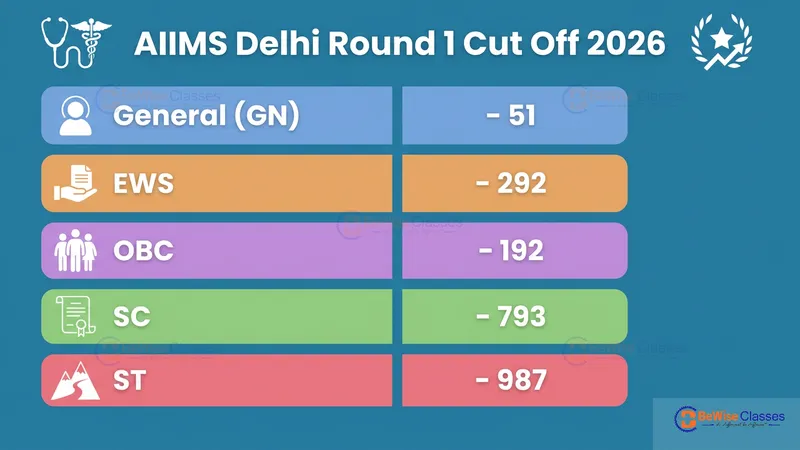


























 .
.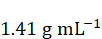
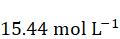


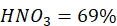








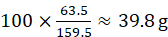




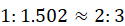

















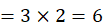
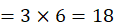



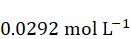

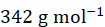


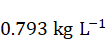

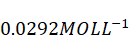



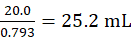


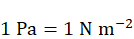
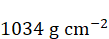
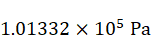








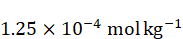
















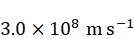










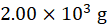
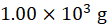
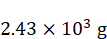


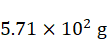
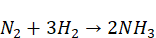
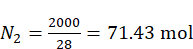
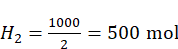






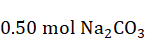
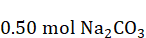
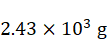
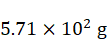










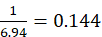


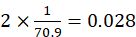





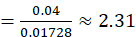


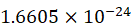

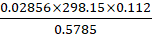












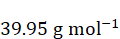


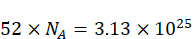

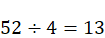


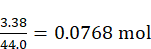
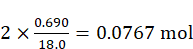


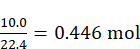
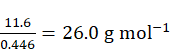
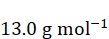











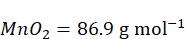
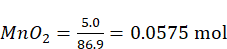










 NCERT Solutions
 Neet 2025
 Top Medical Colleges in India
 Neet Results & Answer Key
 NEET Previous Year Papers
 NEET Mock Test
 Strategy NEET Motivation
.png) NEET Application Form & Registration
NEET Application Form & Registration NEET Exam Update & News