Download Chemistry Chapter Wise Weightage for NEET 2027 PDF | Get List of Most Important Chemistry Chapters
10/2/2026
Download Chemistry Chapter Wise Weightage for NEET 2027 PDF | Get List of Most Important Chemistry Chapters
Are you struggling to decide which Chemistry chapters deserve your maximum study hours and can help you to score more in NEET? Understanding the chemistry chapter wise weightage for neet 2027 is the most efficient way to prioritize your preparation and maximize your score. This guide breaks down exactly how many questions to expect from Physical, Organic, and Inorganic sections, helping you build a targeted strategy for the 180 marks in NEET Chemistry.
Organic Chemistry remains the highest weightage section with approximately 16-18 questions expected.
Coordination Compounds and Chemical Bonding are the highest-yield inorganic chapters.
Physical Chemistry weightage for NEET is roughly 35%, focusing heavily on Electrochemistry and Thermodynamics.
Class 12 syllabus contributes slightly more to the overall question count than Class 11 in NEET Exam.
Acing the NEET exam requires a calculated approach to the vast syllabus rather than just brute-force studying. Chemistry often acts as the primary rank-booster because it balances the logical problem-solving of Physics with the factual recall required in Biology. By analyzing the chemistry chapter wise weightage for neet 2027, you can pinpoint exactly which units offer the highest return on your study hours.
Recent paper trends from 2022 to 2026 indicate that the NTA is focusing heavily on NCERT-based questions. This shift means your success depends on understanding the Chemistry question distribution, particularly in high-yield areas like Organic and Inorganic Chemistry. We have meticulously compiled this data to help you navigate the 180-mark Chemistry question distribution with precision and confidence.
Whether you are a Class 11 student building your foundation or a Class 12 student in the final stages of revision, this blueprint provides the exact weightage you need. We will now break down the specific Chemistry chapters and their expected question counts to reveal where the most scoring opportunities are hidden.
Sectional Distribution: Physical, Organic, and Inorganic Weightage in NEET
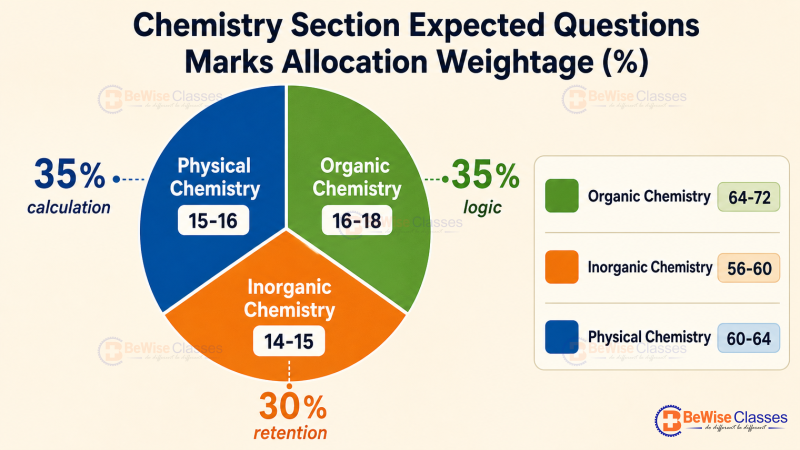
Before looking at individual chapters, it is helpful to see how the NTA balances the three main pillars of Chemistry. Each section requires a different cognitive skill set: calculation for Physical, logic for Organic, and retention for Inorganic.
Chemistry Section
Expected Questions
Marks Allocation
Weightage (%)
Organic Chemistry
16-18
64-72
35%
Inorganic Chemistry
14-15
56-60
30%
Physical Chemistry
15-16
60-64
35%
Chemistry section weightage compares questions, marks allocation, and cognitive skills.
Physical Chemistry Chapter Wise Weightage for NEET 2027
Physical Chemistry is often where NEET aspirants struggle the most due to the heavy reliance on numerical problem-solving and conceptual application. However, once you develop a strong grip on the underlying formulas, these chapters become the most scoring part of the Chemistry paper. The physical chemistry weightage for NEET highlights that chapters involving multi-step calculations, such as Electrochemistry and Equilibrium, carry significant importance.
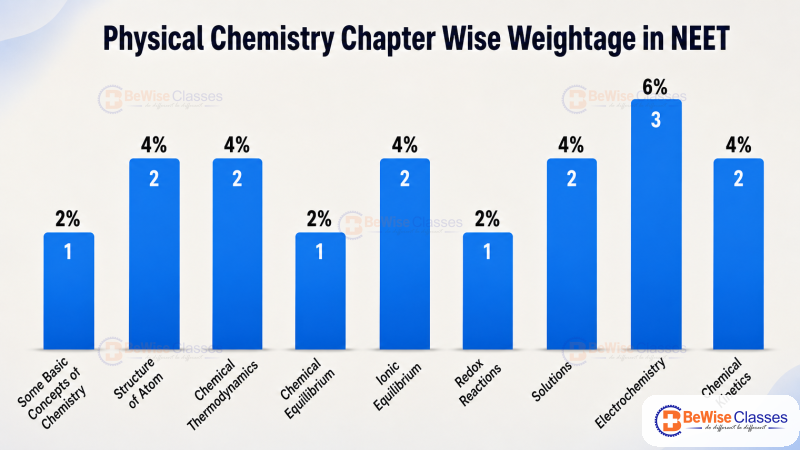
Understanding the distribution of questions helps you decide how much time to allocate to numerical practice versus theory. Below is the detailed marks distribution for all Physical Chemistry chapters, with Chemical and Ionic Equilibrium listed separately to help you plan your preparation better:
To excel here, you must prioritize the Mole concept as it forms the foundation for all other chapters. Focus on the Nernst equation in Electrochemistry, pH calculations in Ionic Equilibrium, and the application of Le Chatelier's principle in Chemical Equilibrium. Consistent practice with SI units and logarithmic calculations is what separates toppers from average scorers.
Physical Chemistry chapter-wise questions, marks, and weightage distribution.
Inorganic Chemistry Chapter Wise Weightage for NEET 2027
Inorganic Chemistry is often perceived as a memory-heavy subject, but it actually follows a logical framework of periodic trends and structural bonding. The inorganic chemistry chapter wise marks distribution highlights that high-yield topics like Coordination Compounds and Chemical Bonding form the backbone of the entire paper.
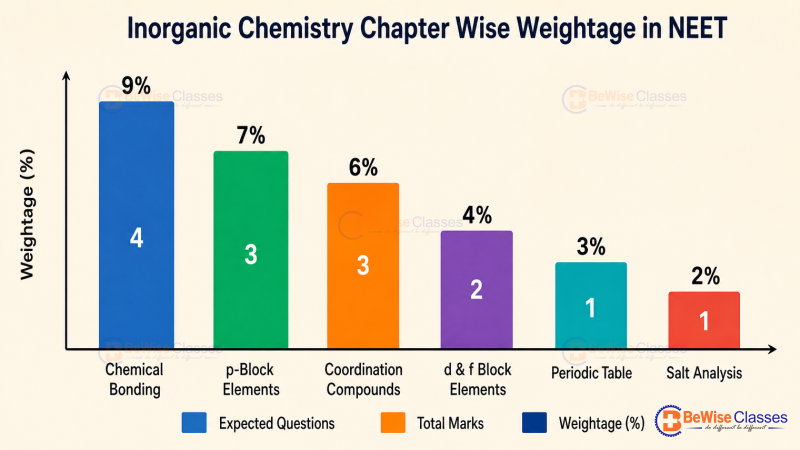
Understanding these trends allows you to predict reactions rather than just memorizing them. Below is the detailed weightage for all Inorganic Chemistry chapters based on recent NEET trends:
Why Focus on Chemical Bonding and Coordination Compounds?
You might wonder, why is chemical bonding important for NEET exam? It is essentially the foundation for every other chapter. Without a clear understanding of VSEPR theory, hybridization, or molecular orbital theory, you will struggle to grasp the geometry and reactivity of molecules in both Organic and Inorganic sections.
Coordination Compounds is equally critical because it is a highly structured chapter. Questions are usually predictable, focusing on IUPAC nomenclature, Crystal Field Theory (CFT), and Isomerism. Mastering these two chapters alone can secure nearly 28 marks, giving you a significant edge in your overall Chemistry score in NEET 2027.
NEET 2027 Preparation Just @Rs 3499
Join BeWise Classes Alpha Batch & Learn with Top Faculty of Kota
Inorganic Chemistry chapter-wise marks distribution and expected questions.
Organic Chemistry Chapter Wise Weightage for NEET 2027
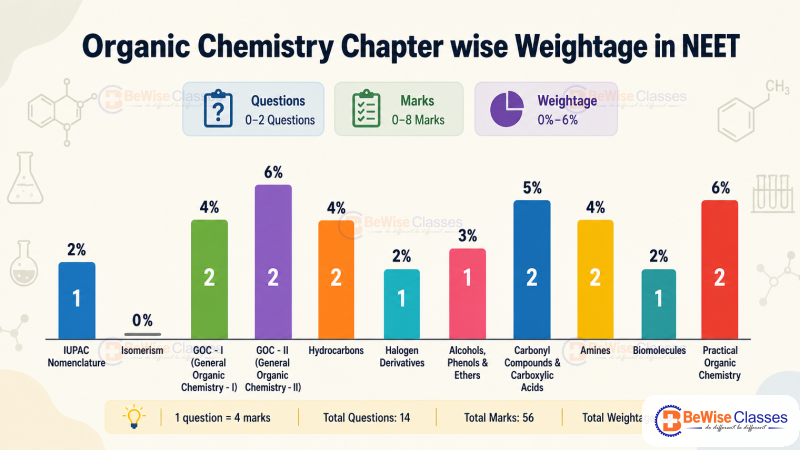
Organic Chemistry is often the most feared section, but it is actually the most logical part of the syllabus. Instead of trying to memorize thousands of isolated reactions, your focus should be on building a conceptual flow. The organic chemistry weightage for NEET 2027 emphasizes GOC and Reaction Mechanisms as the foundational pillars of the subject.
If you master the electronic effects in GOC-I and the mechanisms in GOC-II, you can efficiently tackle complex multi-step conversions. Use the table below to prioritize chapters based on the latest exam trends and their marks distribution.
Chapter Name
Expected Questions
Marks
Weightage (%)
IUPAC Nomenclature
1
4
2%
Isomerism
0
0
0%
GOC - I (General Organic Chemistry - I)
2
8
4%
GOC - II (General Organic Chemistry - II)
2
8
6%
Hydrocarbons
2
8
4%
Halogen Derivatives
1
4
2%
Alcohols, Phenols & Ethers
1
4
3%
Carbonyl Compounds & Carboxylic Acids
2
8
5%
Amines
2
8
4%
Biomolecules
1
4
2%
Practical Organic Chemistry
2
8
6%
A common doubt among aspirants is whether organic chemistry is more important than inorganic for NEET. While the total question count is often similar, Organic Chemistry requires a much higher level of conceptual synthesis. A single advanced question might combine acidic strength comparison from GOC with a specific test from Practical Organic Chemistry. Mastery over these high-yield topics is non-negotiable if you are aiming to score above 160 in the Chemistry section.
Most Important Chapters for NEET Chemistry: The Do-or-Die List
If you are working against a tight schedule, you cannot afford to treat every topic with the same level of depth. To optimize your score, you must prioritize your study plan based on the latest NTA exam patterns and the chemistry chapter wise weightage for neet 2027. Identifying each Chemistry High Weightage Chapter early in your preparation allows you to channel your energy toward the topics where the most marks are concentrated.
High-Yield Chemistry Chapters
The following list represents the Chemistry Most Important Chapter selection for any serious aspirant. These topics form the core of the NEET paper and should be mastered during your initial preparation and first major revision cycle.
Chapter Name
Expected Questions
Key Focus Areas
Coordination Compounds
3-4
Werner’s theory, VBT, and Crystal Field Theory.
Chemical Bonding
3
VSEPR theory, Hybridization, and Molecular Orbital Theory.
GOC (I & II)
4
Inductive effect, Resonance, and Stability of Intermediates.
Hydrocarbons
3
Alkanes, Alkenes, and Alkynes; focus on named reactions.
Carbonyl Compounds
3
Aldehydes and Ketones; Nucleophilic addition reactions.
Electrochemistry
2-3
Nernst equation, Kohlrausch's law, and Faraday's laws.
Thermodynamics
2-3
First and second laws, Enthalpy, and Gibbs Free Energy.
Class 11 Chemistry High Weightage Chapters
Securing a high rank requires a strong grasp of Chemistry High Weightage Chapters from the Class 11 syllabus, as they lay the groundwork for advanced concepts. Mastering these topics ensures you do not struggle when transitioning to complex Class 12 modules.
For instance, Equilibrium is critical for building numerical proficiency, with an expectation of at least 3 questions in the exam. It is important to remember that ionic equilibrium is often more challenging than chemical equilibrium, so allocate your study hours accordingly. While Thermodynamics and Hydrocarbons are Class 11 subjects, their concepts are frequently integrated with Class 12 reactions, making them essential for a top score.
Strategic Preparation: How to Score 160 Plus in NEET Chemistry 2027
Knowing the weightage is only half the battle. The real challenge is knowing how to prepare for NEET 2027 chemistry chapter wise so that you actually retain the information during the three-hour exam window.
Step 1: NCERT Dominance
For Inorganic and Organic sections, NCERT is your bible. Many questions are picked directly from the tables and "Note" boxes in the textbook. Do not jump to reference books until you have read NCERT at least three times.
Step 2: Formula and Reaction Mapping
Create a formula sheet for Physical Chemistry. For Organic, build a "Reaction Map" where you connect reagents to products. This helps you visualize how one functional group converts to another, which is crucial for solving multi-step conversion questions.
Step 3: Solve Previous Year Questions (PYQs)
Analyze the trends from 2017 to 2026. You will notice that while the specific questions change, the concepts (like the acidic strength of phenols or the hybridization of Xe compounds) are repeated almost every year. Attempt 10 Years NEET PYQs Paper in CBT Mode | 100% FREE
Mastering the chemistry chapter wise weightage for neet 2027 is the fastest way to turn a mediocre score into a medical seat. By focusing on Coordination Compounds, GOC, and Electrochemistry, you secure a massive portion of the marks with targeted effort. Start your preparation today by downloading the NTA NEET chemistry chapter wise weightage PDF and mapping out your study schedule. For more resources, check our Download NEET 2027 Syllabus PDF to ensure you are aligned with the latest updates.
NEET 2027 Preparation Just @Rs 3499
Join BeWise Classes Alpha Batch & Learn with Top Faculty of Kota
Which chapter has the highest weightage in NEET chemistry?
Coordination Compounds and General Organic Chemistry (GOC) typically have the highest weightage, often yielding 4 questions each. Following these, Chemical Bonding and Electrochemistry are also high-yield chapters that students must prioritize.
Is the NEET 2027 syllabus changed?
As of the latest updates for 2026-2027, the syllabus remains aligned with the rationalized NCERT curriculum. However, the NTA often releases final syllabus notifications a few months before the exam, so students should focus on the current NCERT chapters.
How many questions are asked from equilibrium in NEET?
In recent years, the Equilibrium chapter (including both Chemical and Ionic) has contributed approximately 3 questions to the NEET chemistry paper. It is a significant chapter that requires a strong grasp of both concepts and numerical applications.
Is NCERT enough for NEET chemistry 2027?
NCERT is sufficient for about 90-95% of the exam, especially for Inorganic and Organic sections. For Physical Chemistry, while the concepts are from NCERT, you will need extra practice from standard problem-solving books to handle numerical complexity.
What is the weightage of Class 11 and 12 chemistry in NEET?
Class 12 chemistry usually carries a slightly higher weightage, approximately 52-55%, compared to Class 11, which carries 45-48%. However, Class 11 chapters like Bonding and GOC are essential to understanding the Class 12 syllabus.
Can I skip p-block elements for NEET 2027?
Skipping p-block is not recommended as it consistently yields at least 2 questions. Since it is largely memory-based and questions often come directly from NCERT lines, it provides an easy opportunity to score marks quickly.
Which part of chemistry is toughest in NEET?
Most students find Physical Chemistry the toughest due to the calculation-heavy nature of chapters like Thermodynamics and Ionic Equilibrium. Organic Chemistry can also be challenging if the fundamentals of General Organic Chemistry (GOC) are not clear.
What are the Do or Die chapters for NEET chemistry?
The 'Do or Die' chapters include Coordination Compounds, Chemical Bonding, GOC, Hydrocarbons, and Electrochemistry. Mastering these five topics alone can help you secure a significant portion of the total 180 marks.