ReNEET 2026 Paper New Guidelines | NTA Increases Rough Space & Clarifies Why 15 Minutes Extra Time | Latest Notice
6/12/2026
ReNEET 2026 Paper New Guidelines | NTA Increases Rough Space & Clarifies Why 15 Minutes Extra Time | Latest Notice
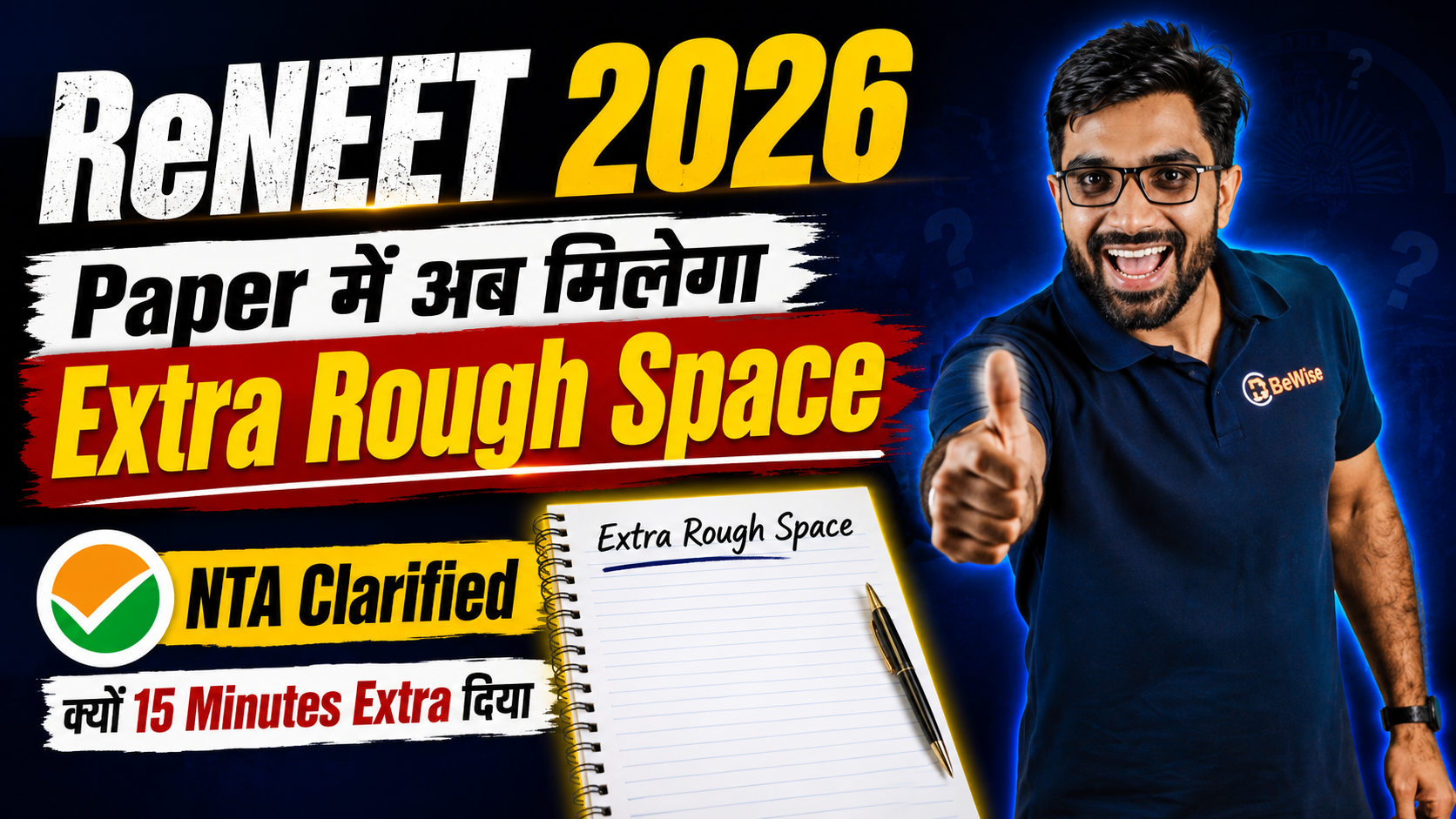
Are you worried about running out of ReNEET 2026 Extra Rough Pages during your physics calculations? NTA recently announced dedicated student-friendly measures to address this exact concern for the upcoming June 21 exam. This update changes how you will manage your rough work and adjust to the modified paper layout. We will explore these new NTA NEET rough work sheet rules and how they impact your attempt strategy.
Key Takeaways
NTA has doubled the rough work space from two pages to four pages for ReNEET 2026.
The exam duration is extended to 195 minutes (2:00 PM to 5:15 PM) to accommodate administrative tasks.
Rough pages are now strategically split between the beginning and the end of the question booklet.
Over-utilizing extra space can lead to time management issues and missed questions.
The National Testing Agency has officially recognized the stress students face when dealing with complex calculations in limited spaces. For the ReNEET 2026 scheduled on June 21, 2026, several significant shifts in the paper design have been confirmed. These changes aren't just about adding paper; they are about improving the overall experience of the candidate during a high-stakes medical entrance exam.
Understanding these ReNEET 2026 Extra Rough Pages is vital for any serious aspirant. While the extra space is a welcome relief for those heavy physics and chemistry numericals, it also brings new challenges in paper management. If you are not careful, the layout changes could lead to confusion during the peak pressure of the examination.
In this guide, we will break down the latest NTA notice, the specific layout of the new booklets, and the potential drawbacks of having more space than you might actually need. Let’s look at exactly what the NTA has planned for the 2026 session.
Official NTA Notice: Student Friendly Measures for ReNEET 2026 Extra Rough Pages
On 12 June 2026, the National Testing Agency (NTA) released a public notice regarding the NEET (UG)-2026 examination. The agency aims to make the process more responsive to candidate needs. The most notable change involves the ReNEET 2026 Extra Rough Pages, which have been increased to ensure candidates don't feel restricted during complex problem-solving. This change is valid for both English and regional language versions of the paper.
Feature
Details for ReNEET 2026
Exam Date
21 June 2026
Exam Timing
2:00 PM to 5:15 PM
Total Duration
195 Minutes
Total Rough Pages
4 Pages (Previously 2)
Why NTA Added 15 Minutes to the RE-NEET 2026 Guidelines
The examination window has been officially extended to 195 minutes. NTA clarified that this additional time is provided specifically to handle mandatory formalities like signing attendance sheets and invigilation procedures. This ensures your core three hours for solving the paper remain untouched by administrative interruptions.
New Booklet Design: Placing the ReNEET 2026 Extra Rough Pages
The way you interact with the NEET exam booklet instructions is changing. In previous years, rough work space was typically found only at the end of the booklet. Based on feedback, especially from left-handed candidates, the NTA has redesigned the layout for better accessibility. This new setup is intended to make the examination process more comfortable.
Instead of searching for space at the very back, candidates will now find the four pages distributed throughout the booklet. Two rough-work pages are now placed immediately after the instruction page at the beginning, and the remaining two pages stay at the end. This allows you to choose the most convenient location for your calculations without flipping through the entire booklet repeatedly.
Risks of More Space: Why ReNEET 2026 Extra Rough Pages Can be Deceptive
While having more space seems universally positive, there are hidden drawbacks that could affect your score. Being aware of these can help you maintain focus during the 21 June 2026 session.
The Trap of Unnecessary Calculations
When we have limited space, we tend to be very concise and mentally check small steps. With the ReNEET 2026 Extra Rough Pages, there is a risk of writing down every single step. This often lead to wasting precious seconds on calculations that could have been done mentally, potentially causing you to fall behind the clock.
The Danger of Missing Questions
With more pages in the booklet, paper management becomes more difficult. Many students have faced situations where they accidentally skip an entire page of questions because it was sandwiched between rough sheets or the revised layout felt unfamiliar. You must remain vigilant to ensure you have seen every question from number 1 to 200.
Using the NTA NEET rough work sheet effectively requires a planned approach. Since you now have two pages at the front and two at the back, consider dividing your subjects accordingly. For instance, use the front pages for Chemistry and the back pages for the more extensive Physics calculations. This avoids the clutter that happens when you mix different problems on the same sheet.
Remember that while NTA is providing four pages, they are still finite. You cannot ask for additional rough sheets in ReNEET. It is also important to note that the back of the OMR sheet must never be used for rough work, as this can interfere with the machine grading process. Stick to the designated zones provided in the booklet.
Best Way to Organize Rough Work for NEET Physics
Physics requires organized steps to avoid calculation errors. A good technique is to divide each rough page into four quadrants using simple lines. Solve one question per quadrant. This makes it easier to go back and check your work if you find an answer doesn't match the options. In a medical entrance exam rough space, neatness is your best friend. If your rough work is a chaotic mess, you might misread your own handwriting and pick the wrong option on the OMR.
Strictly speaking, you are not allowed to carry or use a pencil for rough work in NEET 2026. The National Testing Agency (NTA) mandates the use of a non-transparent ballpoint pen, which will be provided to you at the examination center itself. You must not bring your own pen or any additional stationery into the hall.
Since all calculations and diagrams on the rough sheets must be done using the provided pen, it is important to practice your mock tests similarly. This helps you get used to managing space without the option of erasing mistakes.
The table below summarizes the official stationery guidelines for the exam:
Item
Allowed?
Source
Personal Pen/Pencil
❌ No
Candidates cannot carry their own stationery.
NTA Provided Pen
✅ Yes
Distributed inside the exam hall by invigilators.
Eraser/Sharpener
❌ No
Prohibited as they are part of "Barred Items."
Rough Work Sheets
✅ Yes
4 pages integrated within the test booklet.
Comparing the Old vs. New NEET Exam Booklet Instructions
To visualize the shift in RE-NEET 2026 guidelines, let's compare how the question paper has evolved compared to previous years.
Feature
Previous Pattern
New 2026 Pattern
Rough Page Count
2 Pages
4 Pages
Page Distribution
Only at the end
2 at beginning, 2 at end
Administrative Time
Overlapped with exam
Extra 15 mins allocated
Standard Time
180 Minutes
195 Minutes
Comparison of RE-NEET 2026 guidelines showing increased rough space and updated exam duration.
The introduction of ReNEET 2026 Extra Rough Pages and the 195-minute window are major steps by the NTA to reduce candidate pressure. By providing four pages across the booklet, NTA has addressed accessibility and calculation space concerns. However, it is up to you to manage this space without wasting time or missing questions. Stay focused, keep your calculations organized, and use the extra time to ensure your OMR marking is flawless. For any further doubts, reach out to the NTA helpline at +91-11-40759000.
Want to Crack NEET 2027 with 700+ Marks?
Join Our DREAM 2027 Batch & learn with Top Faculty from Kota
How many rough pages are in the NEET 2026 question paper?
There are now a total of four pages provided for rough work in the NEET 2026 exam booklet. This is a significant increase from previous years where only two pages were available.
Can I ask for additional rough sheets in ReNEET?
No, you cannot ask for additional rough sheets during the exam. NTA provides a fixed number of pages within the question booklet itself, and no extra loose sheets are allowed or provided by the invigilators.
Where to do calculations in NEET question paper?
Calculations should be done only on the designated blank pages labeled for rough work. In ReNEET 2026, two of these pages are located at the beginning of the booklet after the instruction page, and two are at the end.
Is extra paper allowed for rough work in NEET?
No, secondary paper is strictly prohibited. You are not allowed to bring your own paper into the hall, and the center will not provide any paper outside of what is bound within your official question booklet.
Can I write on the question paper for rough work?
While small markings on questions are common, official NTA rules specify that all major calculations and rough work should be confined to the dedicated rough work pages provided at the start and end of the booklet.
What to do if rough work space is full in NEET?
If you run out of space, try to find small gaps in the existing rough pages or write in smaller handwriting. However, with the new four-page layout for 2026, most students should find the space sufficient if they organize their work efficiently.
Can we use the back of the OMR sheet for rough work?
Absolutely not. Using the back of the OMR sheet for rough work can lead to disqualification or technical errors during the scanning process. Never make any stray marks on the OMR sheet other than your required details and answers.
Are rough sheets collected after the NEET exam?
Since the rough pages are part of the question booklet, they remain with the booklet. Depending on the rules for the specific year, you may be allowed to take the question booklet home, but the OMR sheet is always collected by the invigilator.










.png)