Download Class 11 Chemistry Chapter 1 NCERT Solutions PDF – Some Basic Concepts of Chemistry Step by Step Explanation
8/17/2026
Class 11 Chemistry Chapter 1 NCERT Solutions: Step-by-Step Explanations
Are you finding the transition from class 10 to competitive class 11 chemistry a bit overwhelming? Mastering the class 11 chemistry chapter 1: Some Basic concept of Chemistry is your first major step toward cracking exams like NEET. In this guide, we provide class 11 chemistry chapter 1 NCERT solutions & answers with conceptual clarity to help you understand the mole concept and stoichiometry. This guide ensures you build a solid foundation for your upcoming class 11 board exam and entrance examinations like NEET, JEE Mains & CUET.
Key Takeaways
Comprehensive step-by-step solutions for all 36 NCERT exercise questions of Class 11 Chemistry Chapter 1.
Detailed explanations of the Mole Concept, Stoichiometry, and Limiting Reagents.
Summary table of essential formulas including Molarity, Molality, and Mole Fraction.
Practical tips to avoid common calculation errors in empirical and molecular formulas.
Starting your Class 11 journey with Chemistry often feels like learning a new language. This first chapter, Some Basic Concepts of Chemistry, introduces the fundamental building blocks you will use throughout your Class 11 & Class 12. Whether you are calculating the mass of an atom or determining the yield of a reaction, the principles laid out here are non-negotiable for success in competitive exams like NEET.
Many students struggle initially because they try to memorize formulas without understanding the underlying logic. Our Class 11 Chemistry Chapter 1 NCERT Solutions aim to bridge that gap by focusing on the "why" behind each step. By developing these analytical skills, you can approach school tests and entrance exams like NEET, JEE Mains & CUET with much more confidence.
To help you master these topics, we have provided a detailed Some Basic Concepts of Chemistry NCERT Solution guide that covers every exercise question. You can also download PDF of Class 11 Chemistry Chapter 1 NCERT Solution to keep as a handy reference during your daily practice sessions. This resource is designed to simplify complex topics like stoichiometry and the mole concept, ensuring your foundation is rock solid.
Essential Formulas and Chapter Summary
Before diving into the exercise solutions, it is crucial to have the key mathematical tools at your fingertips. These some basic concepts of chemistry class 11 solutions rely heavily on a few core concentration terms, mole relationships, and laws. The following table summarizes the formulas you will need to solve almost every numerical problem in this chapter.


        Concept
        Formula / Definition


        Mole (n) - From Mass
        n = Given Mass (w)Molar Mass (M)


        Mole (n) - From Number
        n = Number of Particles (N)Avogadro's Number  (NA)


        Mole (n) - From Volume
        n = Volume at STP (in L)22.4  L


        Molarity (M)
        M = Moles of soluteVolume of solution in Litres


        Molality (m)
        m = Moles of soluteMass of solvent in kg


        Mole Fraction (x)
        xA = nAnA + nB


        Mass Percent
        Mass of soluteTotal mass of solution × 100
Chemistry isn't random subject; it follows strict rules. You'll encounter five main laws: the Law of Conservation of Mass, Definite Proportions, Multiple Proportions, Gay Lussac’s Law, and Avogadro’s Law. For instance, the Law of Multiple Proportions states that if two elements form more than one compound, the masses of one element that combine with a fixed mass of the other are in a ratio of small whole numbers. This is a favorite topic for important questions for class 11 chemistry chapter 1.
The mole is simply a counting unit, like a dozen. However, instead of 12, it represents 6.022 × 10²³ particles. When students look for class 11 chemistry chapter 1 exercise solutions, the most common hurdle is converting between mass, moles, and number of atoms.
To calculate the molar mass of a compound like H2SO4, you sum the atomic masses: 2 × 1.008 (H) + 32.06 (S) + 4 × 16.00 (O) = 98.076 g/mol.
Remember, atomic mass is for a single atom (in amu), while molar mass is for one mole of atoms (in grams). They are numerically similar but represent very different scales.
Stoichiometry and Limiting Reagents
Stoichiometry is the bookkeeping of chemistry. It allows us to predict how much product we can get from a certain amount of reactant. The first step is always to write a balanced chemical equation. For example, in the production of ammonia:
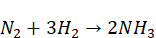
N2(g) + 3H2(g) → 2NH3(g)
This tells us that 1 mole of nitrogen reacts with 3 moles of hydrogen. If you have less hydrogen than required by this ratio, hydrogen becomes the limiting reagent. It is the reactant that is completely consumed first, stopping the reaction and limiting the final amount of product formed.
Think of it like making a sandwich. If you have 10 slices of bread and 2 slices of cheese, and each sandwich requires 2 bread + 1 cheese, the cheese will run out first. In chemical terms, you calculate the required moles of each reactant and compare them to what you actually have. The one that yields the least amount of product is your limiting reagent.
Step-by-Step Class 11 Chemistry Chapter 1 NCERT Exercise Solutions
Here we tackle the specific problems found in the NCERT textbook. These are essential for mastering the ncert solutions for class 11 chemistry chapter 1 pdf curriculum.
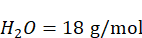
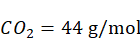
1. Calculate the molar mass of the following:
(i)(ii) (iii)
Solution: Correct Option: , , and .
•Use atomic masses: , , .
•.
•.
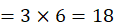
•.
2. Calculate the mass per cent of different elements present in sodium sulphate ().
Solution: Correct Option: Descriptive calculation
•Molar mass of .
•Mass per cent of sodium .
•Mass per cent of sulphur .
•Mass per cent of oxygen .
•Therefore, the elements present are sodium , sulphur , and oxygen .
3. Determine the empirical formula of an oxide of iron, which has 69.9% iron and 30.1% dioxygen by mass.
Solution: Correct Option:
•Assume of the oxide: iron and oxygen.
•Calculate moles: mol Fe and mol O.
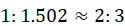
•Divide by the smallest value: Fe:O .
•Multiply by to obtain whole numbers: Fe:O .
•Therefore, the empirical formula is .
4. Calculate the amount of carbon dioxide that could be produced when
(i)1 mole of carbon is burnt in air.
(ii)1 mole of carbon is burnt in 16 g of dioxygen.
(iii)2 moles of carbon are burnt in 16 g of dioxygen.
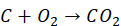
Solution: Correct Option:
•Reaction: .
•(i)mole of carbon in excess air produces mole of g.
•(ii)g of mole, producing mole of g.
•(iii)g of is limiting, producing mole of g.
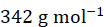
5. Calculate the mass of sodium acetate () required to make 500 mL of 0.375 molar aqueous solution. Molar mass of sodium acetate is 82.0245 g .
Solution: Correct Option:
•Convert volume: .
•Calculate moles: .
•Calculate mass: .
•Required mass of sodium acetate: .
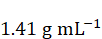
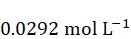
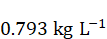
6. Calculate the concentration of nitric acid in moles per litre in a sample which has a density, and the mass per cent of nitric acid in it being 69%.
Solution: Correct Option:
•Mass of solution .
•Mass of of .
•Moles of .
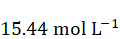
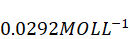
•Concentration .
7. How much copper can be obtained from 100 g of copper sulphate ()?
Solution: Correct Option: 15.44 MOL L^-1
•Molar mass of = .
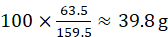
•Mass fraction of copper = .
•Copper obtained from of = .
•Therefore, the amount of copper obtained is approximately .
8. Determine the molecular formula of an oxide of iron, in which the mass per cent of iron and oxygen are 69.9 and 30.1, respectively.
Solution: Correct Option:
•Assume g of the oxide: iron = g and oxygen = g.
•Moles of iron = mol; moles of oxygen = mol.
•Divide by the smaller value: Fe:O = .
•Therefore, the molecular formula is .
9. Calculate the atomic mass (average) of chlorine using the following data:
% Natural Abundance
Molar Mass
34.9689
36.9659
Isotope
% Natural Abundance
Molar Mass
75.77
34.9689
24.23
36.9659
Solution: Correct Option:
The average atomic mass of an element is calculated by finding the weighted average of the masses of its naturally occurring isotopes. The weighting factor for each isotope is its fractional natural abundance.
Use the formula:
Step 1: Convert each percentage abundance into a decimal.
For :
For :
As a check, the fractional abundances add up to :
Step 2: Multiply the fractional abundance of each isotope by its isotopic mass.
Contribution from :
Contribution from :
Step 3: Add the contributions of both isotopes.
Step 4: Round the result appropriately.
Rounding to two decimal places gives:
Therefore, the average atomic mass of chlorine is .
10. In three moles of ethane (), calculate the following:
(i)Number of moles of carbon atoms.
(ii)Number of moles of hydrogen atoms.
(iii)Number of molecules of ethane.
Solution: Correct Option: Answer
•Each molecule contains carbon atoms and hydrogen atoms.
•Moles of carbon atoms mol.
•Moles of hydrogen atoms mol.
•Molecules of ethane molecules.
11. What is the concentration of sugar () in if its 20 g are dissolved in enough water to make a final volume up to 2 L?
Solution: Correct Option:
•Molar mass of = .
•Moles of sugar = .
•Concentration = .
12. The density of methanol is , what is its volume needed for making 2.5 L of its solution?
Solution: Correct Option:
•Moles of methanol required: .
•Mass of methanol required: .
•Convert density: .
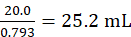
•Volume required: .
•Therefore, the required volume is or .
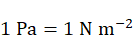
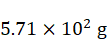
13. Pressure is determined as force per unit area of the surface. The SI unit of pressure, pascal is as shown below:
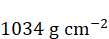
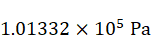
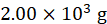
If mass of air at sea level is , calculate the pressure in pascal.
Solution: Correct Option:
•Convert mass per unit area: .
•Use pressure , so .
•Therefore, .
14. What is the SI unit of mass? How is it defined?
Solution: Correct Option: Kilogram (kg)
•The SI unit of mass is the kilogram, symbol .
•It is defined by assigning the exact value to the Planck constant.
15. Match the following prefixes with their multiples:
•Significant figures are the meaningful digits in a measured quantity.
•They include all certain digits and the first uncertain digit.
•They indicate the precision of the measurement.
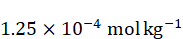
17. A sample of drinking water was found to be severely contaminated with chloroform, , supposed to be carcinogenic in nature. The level of contamination was 15 ppm (by mass).
(i)Express this in per cent by mass.
(ii)Determine the molality of chloroform in the water sample.
Solution: Correct Option: by mass;
•by mass.
•In of water, chloroform present .
•Molar mass of .
•Moles of chloroform .
•Molality .
18. Express the following in scientific notation:
(i)0.0048(ii)234,000(iii)8008 (iv)500.0 (v)6.0012
Solution: Correct Option: Descriptive answer
•(i)
•(ii)
•(iii)
•(iv)
•(v)
19. How many significant figures are present in the following?
(i)0.0025
(ii)208
(iii)5005
(iv)126,000
(v)500.0
(vi)2.0034
Solution: Correct Option: 2, 3, 4, 3, 4, 5
•(i)has significant figures.
•(ii)has significant figures.
•(iii)has significant figures.
•(iv)has significant figures.
•(v)has significant figures.
•(vi)has significant figures.
20. Round up the following upto three significant figures:
•For , retain ; round up to because the next digit is .
•For , retain thousand; round up to because the next digit is .
21. The following data are obtained when dinitrogen and dioxygen react together to form different compounds:
Mass of dinitrogen
Mass of dioxygen
(i)
14 g
16 g
(ii)
14 g
32 g
(iii)
28 g
32 g
(iv)
28 g
80 g
(a)Which law of chemical combination is obeyed by the above experimental data? Give its statement.
(b)Fill in the blanks in the following conversions:
(c)= _____ = _____
(ii)= _____ = _____
(iii)= _____ = _____
Solution: Correct Option: Law of multiple proportions and the given conversions
•The data obey the law of multiple proportions.
•For a fixed mass of dinitrogen, the masses of dioxygen combine in simple whole-number ratios such as and .
•Statement: When two elements form more than one compound, the masses of one element that combine with a fixed mass of the other are in simple whole-number ratios.
•.
•.
•.
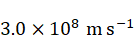
22. If the speed of light is , calculate the distance covered by light in .
Solution: Correct Option: LAW OF MULTIPLE PROPORTIONS; (I) , ; (II) , ; (III) ,
•Convert time: .
•Use .
•.
•Distance covered is .
23. In a reaction
Identify the limiting reagent, if any, in the following reaction mixtures.
(i)300 atoms of A + 200 molecules of
(ii)2 mol A + 3 mol
(iii)100 atoms of A + 100 molecules of
(iv)5 mol A + 2.5 mol
(v)2.5 mol A + 5 mol
Solution: Correct Option: Not applicable
•The reaction requires unit of for every unit of .
•(i)is limiting.
•(ii)is limiting.
•(iii)Neither reagent is limiting.
•(iv)is limiting.
•(v)is limiting.
24. Dinitrogen and dihydrogen react with each other to produce ammonia according to the following chemical equation:
(i)Calculate the mass of ammonia produced if dinitrogen reacts with of dihydrogen.
(ii)Will any of the two reactants remain unreacted?
(iii)If yes, which one and what would be its mass?
Solution: Correct Option: ; remains with mass .
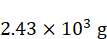
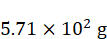
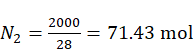
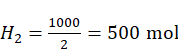
• Balance the equation: . • Moles of . • Moles of . • requires ; hence, is the limiting reactant. • Moles of . • Mass of . • Excess . • Mass of unreacted .
25. How are and different?
Solution: Correct Option: ammonia is produced; dihydrogen remains unreacted, with mass .
•The stated result gives ammonia produced.
•Dihydrogen remains unreacted, with mass .
26. If 10 volumes of dihydrogen gas reacts with five volumes of dioxygen gas, how many volumes of water vapour would be produced?
Solution: Correct Option: 10 volumes of water vapour
•Balanced equation: .
•Volume ratio of is .
•volumes of react with volumes of .
•Therefore, volumes of water vapour are produced.
27. Convert the following into basic units:
(i)28.7 pm
(ii)15.15 pm
(iii)25365 mg
Solution: Correct Option: The converted values are:
•.
•.
•.
28. Which one of the following will have the largest number of atoms?
(A) 1 g Au (s) (B) 1 g Na (s) (C) 1 g Li (s) (D) 1 g of (g)
Solution: Correct Option: C
•For a fixed mass, the number of atoms depends on the moles of atoms.
•g Li contains approximately mol of atoms.
•g contains approximately mol of atoms.
•Li provides the greatest number of atoms.
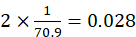
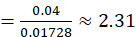
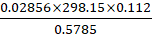
29. Calculate the molarity of a solution of ethanol in water, in which the mole fraction of ethanol is 0.040 (assume the density of water to be one).
Solution: Correct Option: C
•Assume mol of solution: ethanol mol and water mol.
•Mass of water g.
•Volume of water mL L.
•Molarity M.
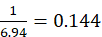
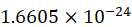
30. What will be the mass of one atom in g?
Solution: Correct Option: C
•Mass of one atom = atomic mass units.
•atomic mass unit = g.
•Mass = g.
31. How many significant figures should be present in the answer of the following calculations?
(i)
(ii)
(iii)
Solution: Correct Option: C
•(i)The result is limited by , so it should have significant figures.
•(ii)The result is limited by , so it should have significant figure.
•(iii)The sum is , which has significant figures.
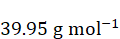
32. Use the data given in the following table to calculate the molar mass of naturally occuring argon isotopes:
Isotope
Isotopic molar mass
Abundance
0.337%
0.063%
99.600%
Solution: - Convert the abundances to decimal fractions: , , and . - Calculate the weighted average: . - Report the molar mass to four significant figures: .
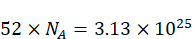
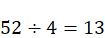
33. Calculate the number of atoms in each of the following (i) 52 moles of Ar (ii) 52 u of He (iii) 52 g of He.
Solution: - Use Avogadro’s number, atoms/mol. - For mol of Ar: atoms. - For u of He: atoms. - For g of He: atoms.
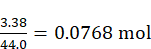
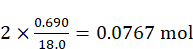
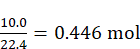
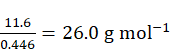
34. A welding fuel gas contains carbon and hydrogen only. Burning a small sample of it in oxygen gives 3.38 g carbon dioxide, 0.690 g of water and no other products. A volume of 10.0 L (measured at STP) of this welding gas is found to weigh 11.6 g. Calculate (i) empirical formula, (ii) molar mass of the gas, and (iii) molecular formula.
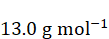
Solution: - Moles of carbon: ; moles of hydrogen atoms: . - The simplest mole ratio is , so the empirical formula is . - Moles of gas at STP: . - Molar mass of the gas: . - Empirical formula mass is ; . - Molecular formula: .
35. Calcium carbonate reacts with aqueous HCl to give , and , according to the reaction,
What mass of is required to react completely with 25 mL of 0.75 M HCl?
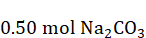
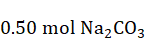
Solution: - Moles of . - From the equation, moles of . - Mass of .
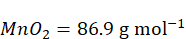
36. Chlorine is prepared in the laboratory by treating manganese dioxide () with aqueous hydrochloric acid according to the reaction
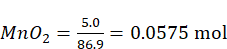
How many grams of HCl react with 5.0 g of manganese dioxide?
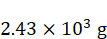
Solution: - Molar mass of . - Moles of . - From the equation, moles of . - Mass of .
Solutions are a huge part of this chapter. You need to be comfortable with Molarity (M) and Molality (m). A common exam question involves converting between the two.
Important Note: Molarity depends on volume, so it changes with temperature. Molality depends on mass, making it independent of temperature. This is a key reason why scientists often prefer molality for precise thermodynamic experiments. If you are preparing for competitive exams, you must know these mole concept questions in class 11 chemistry chapter 1 inside out.
Mastering the class 11 chemistry chapter 1 ncert solutions is not just about passing an exam; it is about building the mental framework required for all future science studies. By practicing these stoichiometry and mole concept problems regularly, you ensure that complex topics later in the year feel much more manageable. For more detailed study materials, you can download the ncert solutions for class 11 chemistry chapter 1 pdf to keep for offline revision. Keep practicing, and don't hesitate to revisit these fundamental laws whenever you feel stuck.
Want to Crack NEET 2027 with 700+ Marks?
Join Our DREAM 2027 Batch & learn with Top Faculty from Kota
What are the some basic concepts of chemistry in class 11?
The core concepts include the mole concept, atomic and molecular masses, stoichiometry, limiting reagents, and various concentration terms like molarity and molality. It also covers the laws of chemical combination and uncertainty in measurements using significant figures.
Where can I download ncert solutions for class 11 chemistry chapter 1 pdf?
You can download the solutions for free from reputable educational platforms like BeWise Classes. In this guide we have uploaded Class 11 Chemistry Chapter 1 NCERT Solution as a PDF to help students study without an active internet connection.
Why are ncert solutions important for class 11 chemistry exams?
NCERT solutions are crucial because they follow the official CBSE syllabus and provide the exact level of detail expected in school exams. Additionally, many competitive exams like NEET and JEE directly base their questions on NCERT exercise patterns.
How many questions are in ncert class 11 chemistry chapter 1?
There are a total of 36 exercise questions at the end of Chapter 1. These range from simple molar mass calculations to complex stoichiometry and concentration conversion problems.
What are the mole concept questions in class 11 chemistry chapter 1?
Questions typically involve calculating the number of atoms in a given mass, finding the mass of a single atom, or determining the number of moles in a solution. For example, calculating the number of atoms in 52 moles of Argon is a standard mole concept problem.
Can I get step by step solutions for class 11 chemistry chapter 1?
Yes, our guide provides step-by-step logic for each question from class 11 chemistry chapter 1, including how to set up the molar ratios and apply the laws of chemical combination. This helps you understand the reasoning rather than just the final numerical answer.
Which is the best reference book for class 11 chemistry chapter 1?
While NCERT is the primary source for NEET Chemistry, mastering the NCERT exercises and question patterns should always be your first priority. To make this practice easier, Sunil Sir has published handwritten Chemistry Notes for Class 11 & 12, specially useful for NEET, JEE Main, CBSE, and CUET aspirants. He has also launched the NCERT Drill Book — a dedicated resource for NCERT-based question practice.























 .
.


















































































































































.png)